Materials & Origins · Chapter 1 of 3

The Ten Materials

Perfumery 101, then ten materials from the rose to Florentine iris: where each grows, and how and when it is harvested.

About 18 minutes of reading

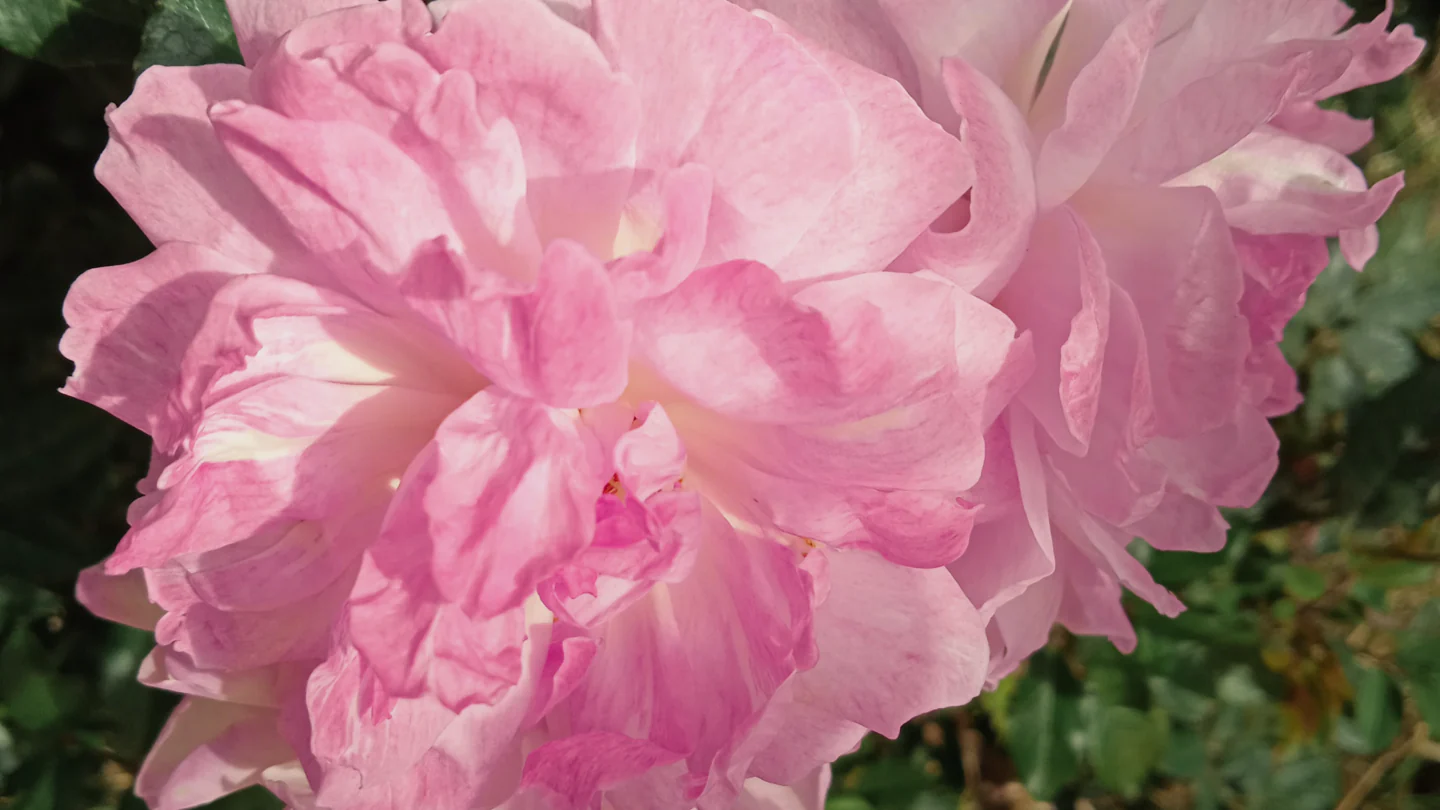
Photo: “Rosa × damascena, Tlemcen” by Riad Salih, CC BY 4.0, via Wikimedia Commons; cropped and color-graded by the house.

New to Perfumery?

Perfumery 101

This is the page I wish someone had handed me at the start. These fundamentals will transform how you experience, choose, and appreciate scent.

01
What is Perfume?

Perfume is a blend of aromatic compounds dissolved in alcohol and water. When you spray it, the alcohol evaporates and leaves the scent molecules on your skin. These molecules slowly release into the air — that’s what you smell. Simple, yet endlessly complex.

02
The Three Notes

Every fragrance unfolds in three stages: Top notes hit first (citrus, herbs) and fade first. Heart notes emerge next (florals, spices) lasting hours. Base notes linger longest (woods, musks) — often for many hours.

03
Why It Smells Different on You

Your unique skin chemistry — pH, oils, bacteria, diet, even medications — interacts with fragrance molecules. That is one reason the same perfume can smell different from one person to the next. Always test on skin, never just paper.

04
Concentration Matters

Parfum carries the highest share of perfume oil and lasts longest. Eau de Parfum balances strength and longevity. Eau de Toilette is lighter. Cologne is freshest but fades fastest. The exact strengths vary from house to house.

05
Natural vs. Synthetic

Natural ingredients come from plants and animals — expensive and variable. Synthetics are lab-created molecules — consistent from batch to batch. Safety depends on the material, not on where it came from. Modern perfumery uses both. Neither is “better” — they serve different purposes.

06
How to Test Properly

Spray on your inner wrist. Wait 30 seconds for alcohol to evaporate. Smell. Wait 10 minutes — smell again. Wait an hour — smell again. Only then do you know the fragrance. Never rush. Never judge on first spray.

Essential Vocabulary

Master these terms and you’ll understand any fragrance review or description.

Sillage
(see-YAHZH) The scent trail a fragrance leaves behind you as you move. Strong sillage means people notice you from across the room.
Projection
How far the scent radiates from your skin. High projection fills a room; low projection stays close, creating an intimate bubble.
Longevity
How long the fragrance lasts on skin. Can range from a couple of hours (light citrus) to a full day or more (heavy ambers). Affected by skin type and climate.
Drydown
The final stage of a fragrance after top and heart notes fade. This is what you’ll smell most of the day — always test before buying.
Nose Blindness
When you stop smelling your own fragrance after wearing it. Your brain tunes it out. Others still smell it — you just can’t.
Accord
A blend of notes that creates a new, unified smell. Like a chord in music — individual notes combine into something greater.
Absolute
A highly concentrated natural extract obtained through solvent extraction. More complete scent profile than essential oils, but more expensive.
House
A perfume brand or company. “Niche houses” (Byredo, Le Labo) focus on artistry. “Designer houses” (Chanel, Dior) balance art with mass appeal.
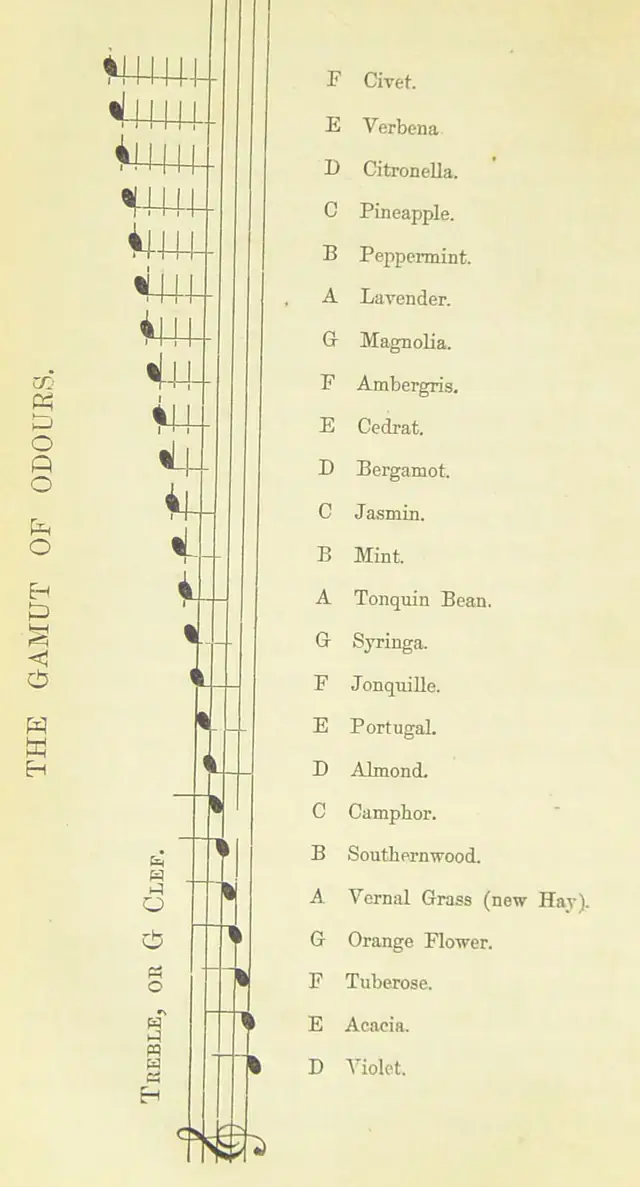
A printed musical stave running down the page with a note on every line and space, each note matched to an odor: civet, verbena and citronella at the top, then lavender, ambergris, bergamot, jasmine and tonquin bean, down to tuberose, acacia and violet; the side title reads The Gamut of Odors, treble or G clef.
Wellcome Collection · book“The Gamut of Odours” (treble clef), from The Art of Perfumery — George William Septimus Piesse, 1862. Wellcome Collection, London. Page 28 of the 1862 edition: Piesse set odors on a musical scale, on the idea that odors blend like notes in a chord. Public Domain Mark (Wellcome Collection): the Wellcome Collection record.

Four Starter Scent Categories

A beginner’s map: four broad groups to start with. The fragrance wheel in the Library refines them.

Floral
Rose, jasmine, lily, violet, iris
Oriental
Vanilla, amber, incense, spices
Fresh
Citrus, green, aquatic, herbal
Woody
Cedar, sandalwood, vetiver, oud

Where Ingredients Come From

Every material in perfumery has a story — a place, a season, a tradition. Understanding provenance deepens appreciation.

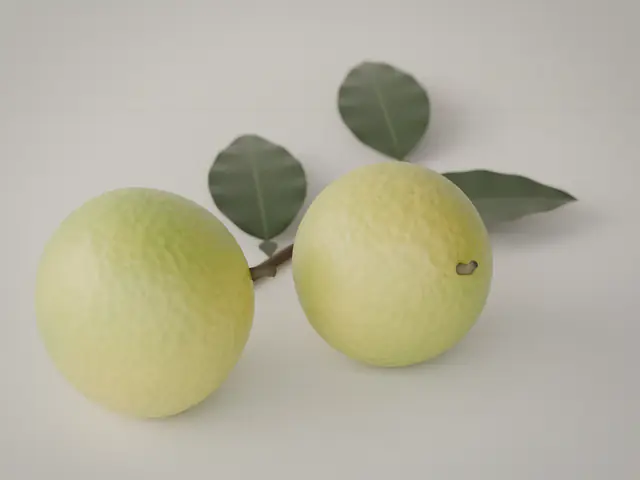
Two round green-yellow bergamot fruits with finely dimpled peel, joined by a short twig with three dark green leaves.
Two bergamots on a twig with its leaves. Modeled and rendered in-house in natural light; not a photograph. © Radler Parfums.
Bergamot
Citrus bergamia
Grown mainly in Calabria, Italy, on a narrow coastal strip. The rind is cold-pressed to extract oil with a bitter-sweet, tea-like character (the house’s reading; on record: characteristic, pleasant, fresh, recalling the bergamot’s peel). A foundation of the classic eau de cologne since the early eighteenth century.
Origin
Reggio Calabria, Italy
Extraction
Cold Expression
Key Molecule
Linalyl Acetate
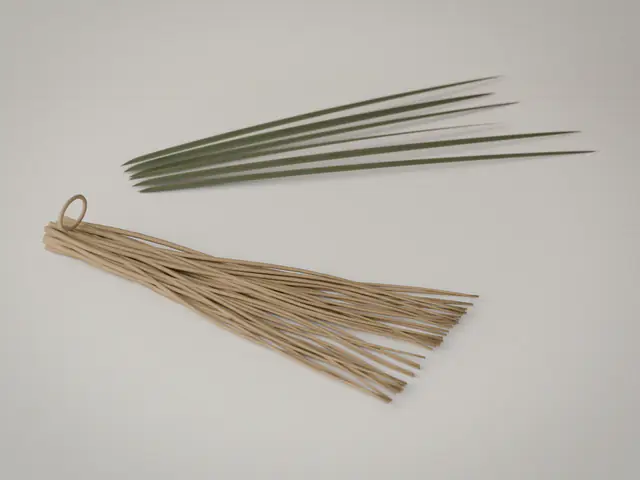
A bundle of fine, pale dried vetiver roots tied at the crown with a small loop, lying on the bench below a few long, narrow green blades of the grass.
Dried vetiver roots tied at the crown, beside a few blades of the grass. Modeled and rendered in-house in natural light; not a photograph. © Radler Parfums.
Vetiver
Chrysopogon zizanioides
The roots of this tropical grass are steam-distilled once the plant is well established. Haitian vetiver is smoky and earthy. Bourbon vetiver from Réunion is cleaner, more refined. Each terroir is distinct.
Prime Sources
Haiti, Réunion, Java
Part Used
Roots
Character
Earthy, Smoky, Deep
Key Molecule
Vetiverol, Khusimol
Tuberose
Agave amica (formerly Polianthes tuberosa)
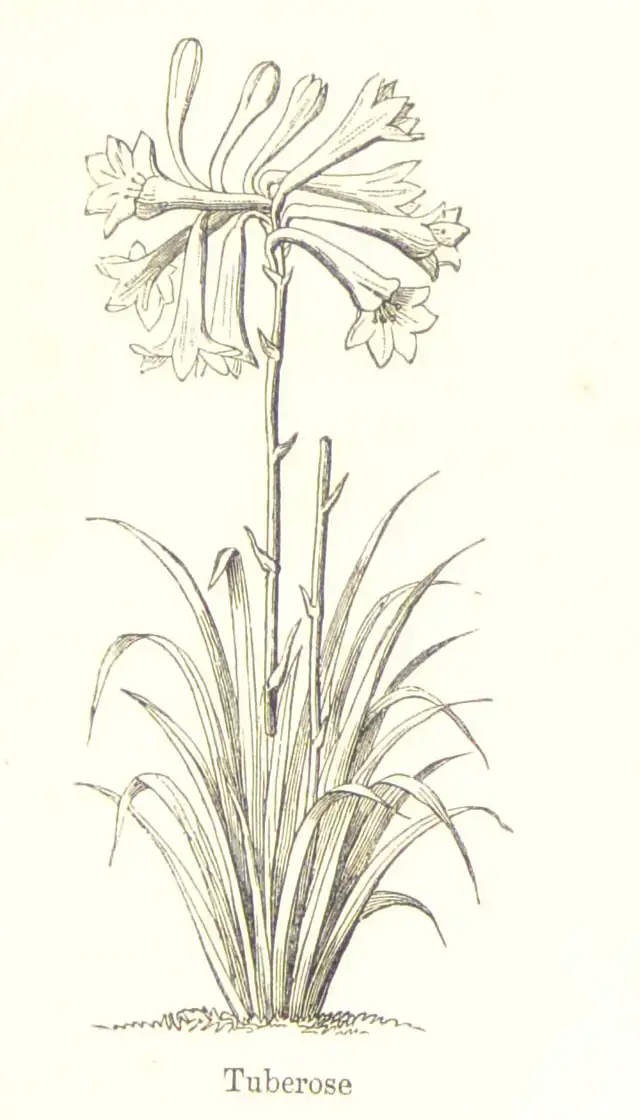
Called “mistress of the night” because its scent intensifies after dark. Hand-picked in India. Its scent was thought so heady that, the story goes, Victorian girls were warned away from it.
A book engraving of a tuberose: a tall bare stem topped by a loose cluster of long-tubed white flowers, rising from a clump of narrow, grass-like leaves, above the printed caption Tuberose.
Wellcome Collection · book“Tuberose”, from The Art of Perfumery — George William Septimus Piesse, 1862. Wellcome Collection, London. Page 147, where Piesse praises the tuberose’s odor, obtained from the flower by enfleurage. Public Domain Mark (Wellcome Collection): the Wellcome Collection record.
Origin
Tamil Nadu, India
Extraction
Enfleurage / Solvent
Character
Narcotic, Creamy, Heady
Labdanum
Cistus ladanifer
Ancient amber substitute. The resin exudes from rockrose leaves under Mediterranean sun. Historically collected from goat beards after grazing. Today, boiled from branches. A foundation of the classic amber accord.
Origin
Spain, Crete, Cyprus
Collection
Summer heat extraction
Forms
Resinoid, Absolute, Oil
Character
Amber, Balsamic, Leathery
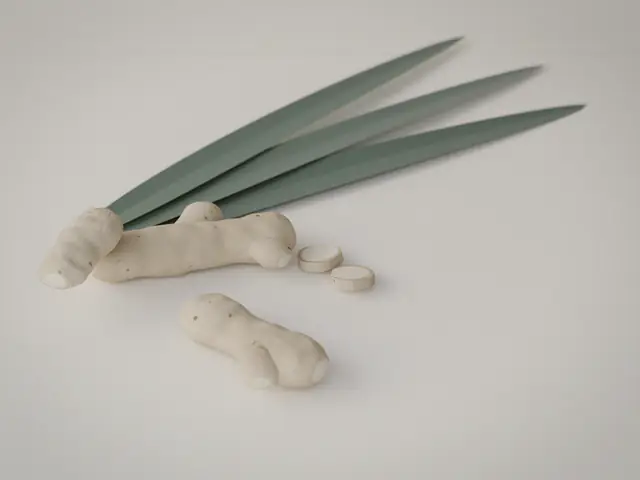
Three pale, knobbly pieces of peeled and dried iris rhizome with cut ends, two thin round slices of it, and three long gray-green iris leaves fanned out behind them.
Pieces of peeled, dried orris root (the iris rhizome) and two cut slices, beside three iris leaves. Modeled and rendered in-house in natural light; not a photograph. © Radler Parfums.
Iris Butter
Iris pallida / Iris germanica
Among the costliest natural materials in perfumery. Iris roots (orris) are dried for several years, during which irones develop. Then steam-distilled to give orris butter (also called orris concrete), from which the absolute is made.
Origin
Florence, Italy / Morocco
Aging
Several years
Key Molecule
Irones (alpha, beta, gamma)
Tonka Bean
Dipteryx odorata
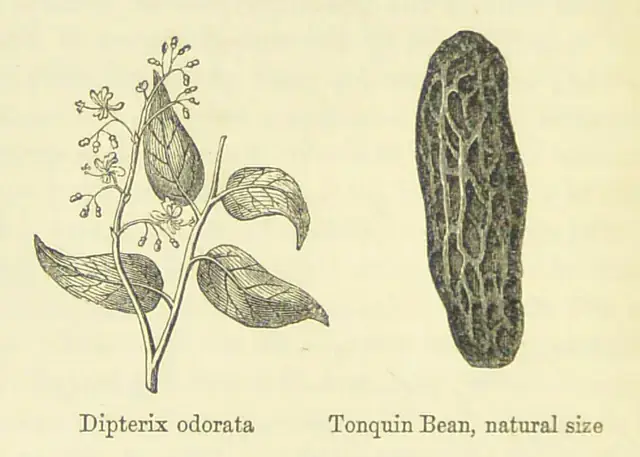
Seeds from the cumaru tree of Venezuela and Brazil. Traditionally soaked in rum and dried, they can develop crystals of coumarin on their surface. The scent is hay, vanilla, almond, caramel — the foundation of the fougère and gourmand families.
A book engraving of a sprig of the tonka tree with leaves and small flowers beside a single long, wrinkled, dark bean drawn at full size, above the printed captions “Dipterix odorata” (an old spelling of Dipteryx odorata) and “Tonquin Bean, natural size”.
Wellcome Collection · bookDipteryx odorata (printed “Dipterix”) and “Tonquin Bean, natural size”, from The Art of Perfumery — George William Septimus Piesse, 1862. Wellcome Collection, London. Page 146: Piesse names coumarin among the bean’s principles and likens its odor to that of new hay. Tonquin is an old name for tonka. Public Domain Mark (Wellcome Collection): the Wellcome Collection record.
Origin
Venezuela, Brazil
Processing
Rum-soaked, air-dried
Extraction
Solvent / CO₂
Key Molecule
Coumarin
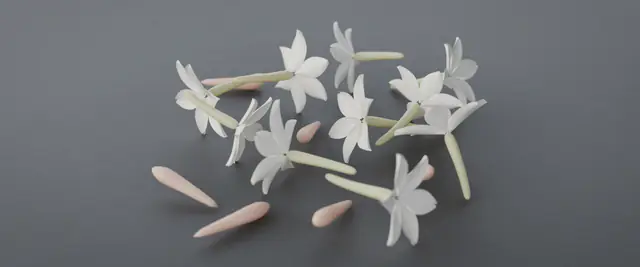
Loose white tuberose flowers, each with six pointed petals on a long pale green tube, scattered on a slate-gray bench among a few plump pale pink buds.
Still life · tuberoseLoose tuberose flowers on the bench: white six-petalled flowers on long green tubes, and pale pink buds. Modeled and rendered in-house in natural light; not a photograph. © Radler Parfums.
6 labeled · 2 unsourced

Evidence for this section: 6 labeled · 2 unsourced

The dive · Kazanlak, Rose Valley, Bulgaria

Rosa damascena

The Rose

Kazanlak, Rose Valley, Bulgaria · 42.6°N · 25.4°EPicking starts in May and lasts 20–30 days · from 5–6 a.m. to about noon
documented

The picking of rose blossom usually begins in May, starting in fields at elevations of 300-400 m above sea-level and continuing for about 20-25 days, when the rose blossoms have attained the required maturity and have 14-40 pinkish red petals and a pleasant and characteristic fragrance.

Publication of an application pursuant to Article 50(2)(a) of Regulation (EU) No 1151/2012 (‘Българско розово масло’… · the source · read 2026-09-27

The EU register gives the season as starting in May and lasting 20–25 days (section 3.5) or 20–30 days (section 5.2); the months shown are worked out from the longer figure, so they reach into June.

the record

coordinates: Wikidata, a representative point · the recordrecord origin/kazanlak-bg · version 4 · updated 2026-10-08 · the data
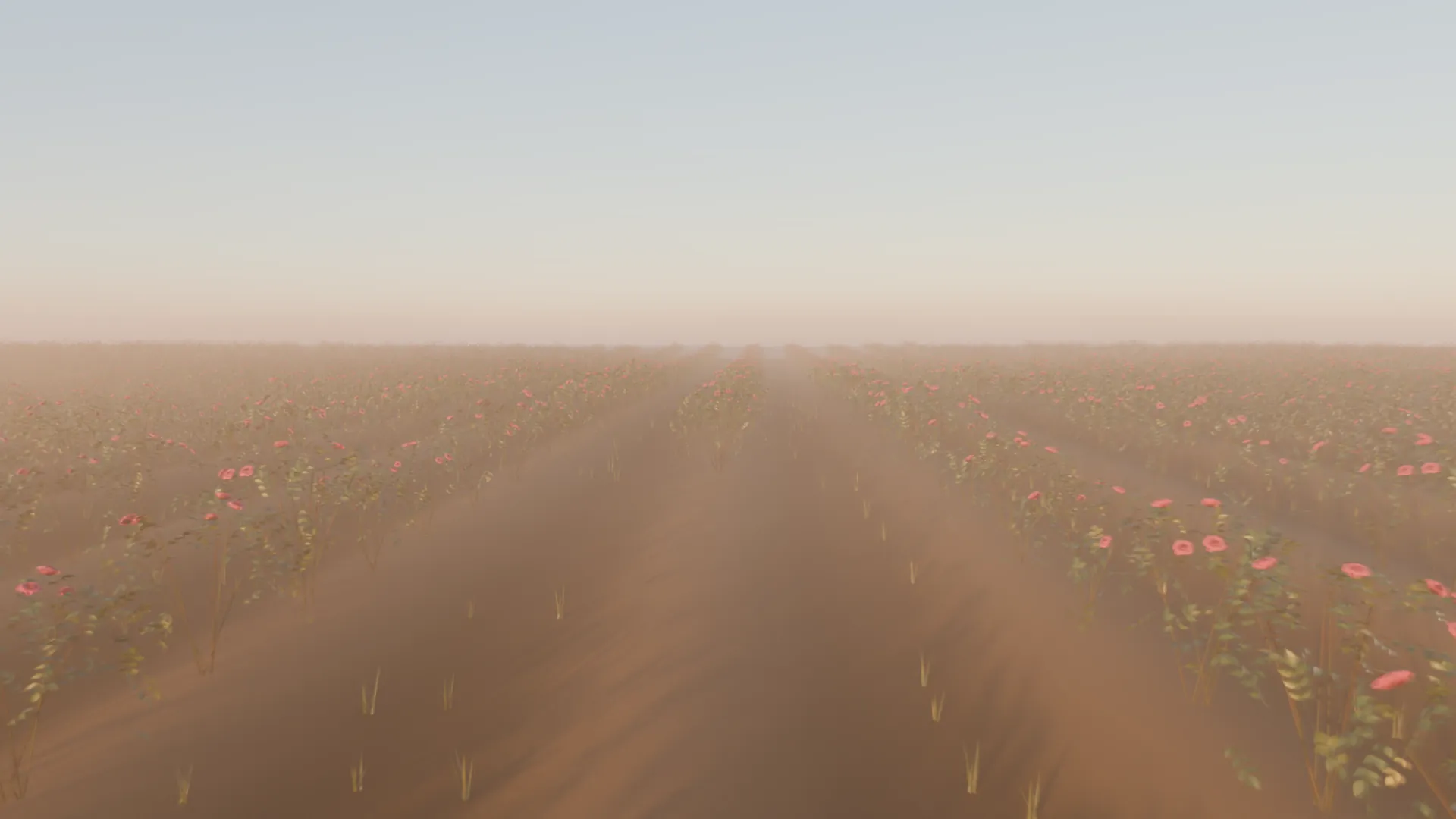
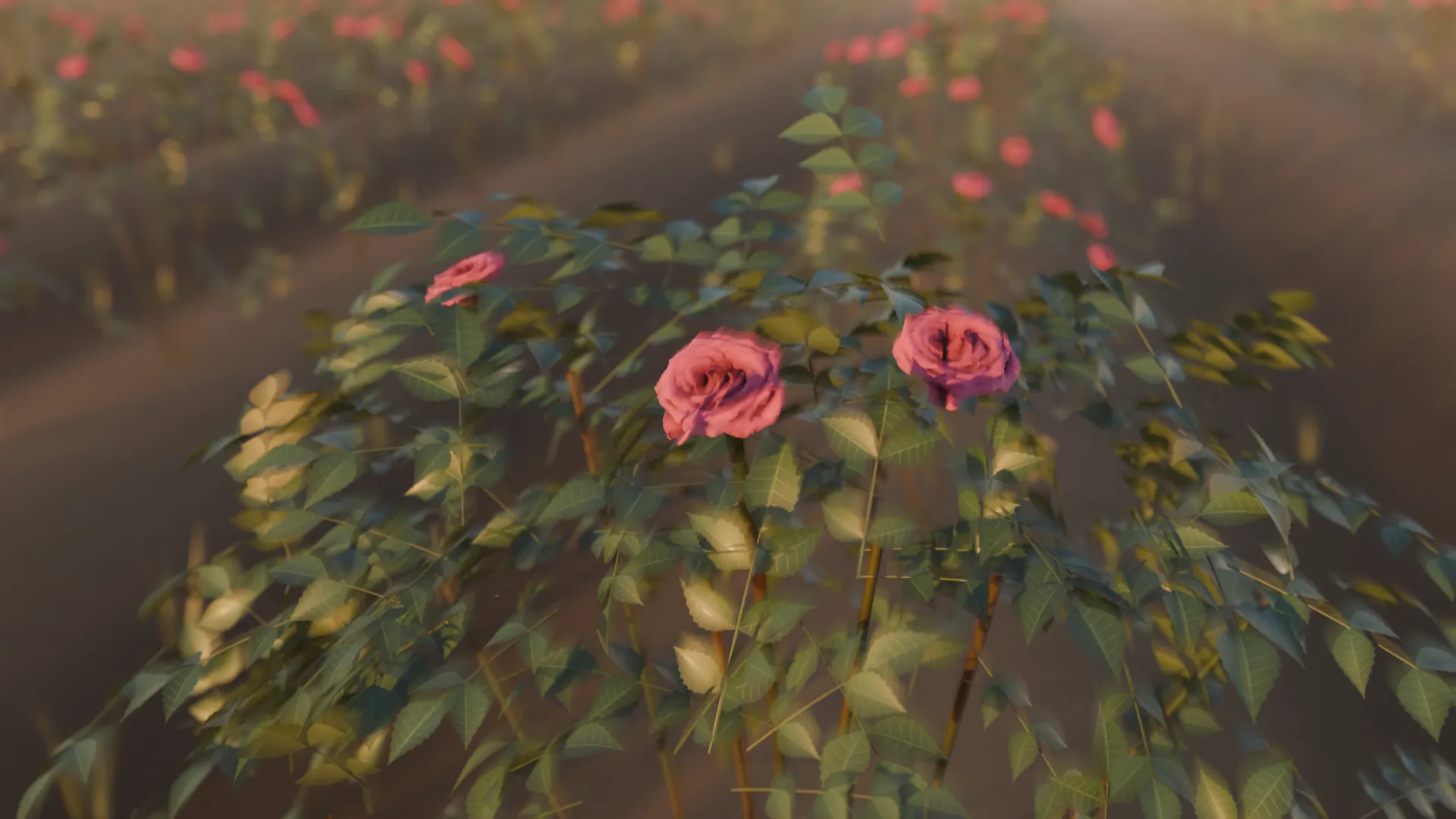
Rows of flowering rose bushes on bare brown earth, running into a morning haze
A field of roses at first light.

The rose

The Rosa damascena is picked for twenty to thirty days from May in the Rose Valley of Bulgaria, near Kazanlak, between the Balkan and Sredna Gora mountain ranges. Picking starts in the early morning and ends around noon, before the heat of the day. It takes an enormous weight of hand-picked petals to make a single kilogram of rose oil. The flowers cannot be machine-harvested; their fragility demands human hands.

One bloom, its petals still wet with dew.
The upper surface of a petal, close enough to see its sheen.
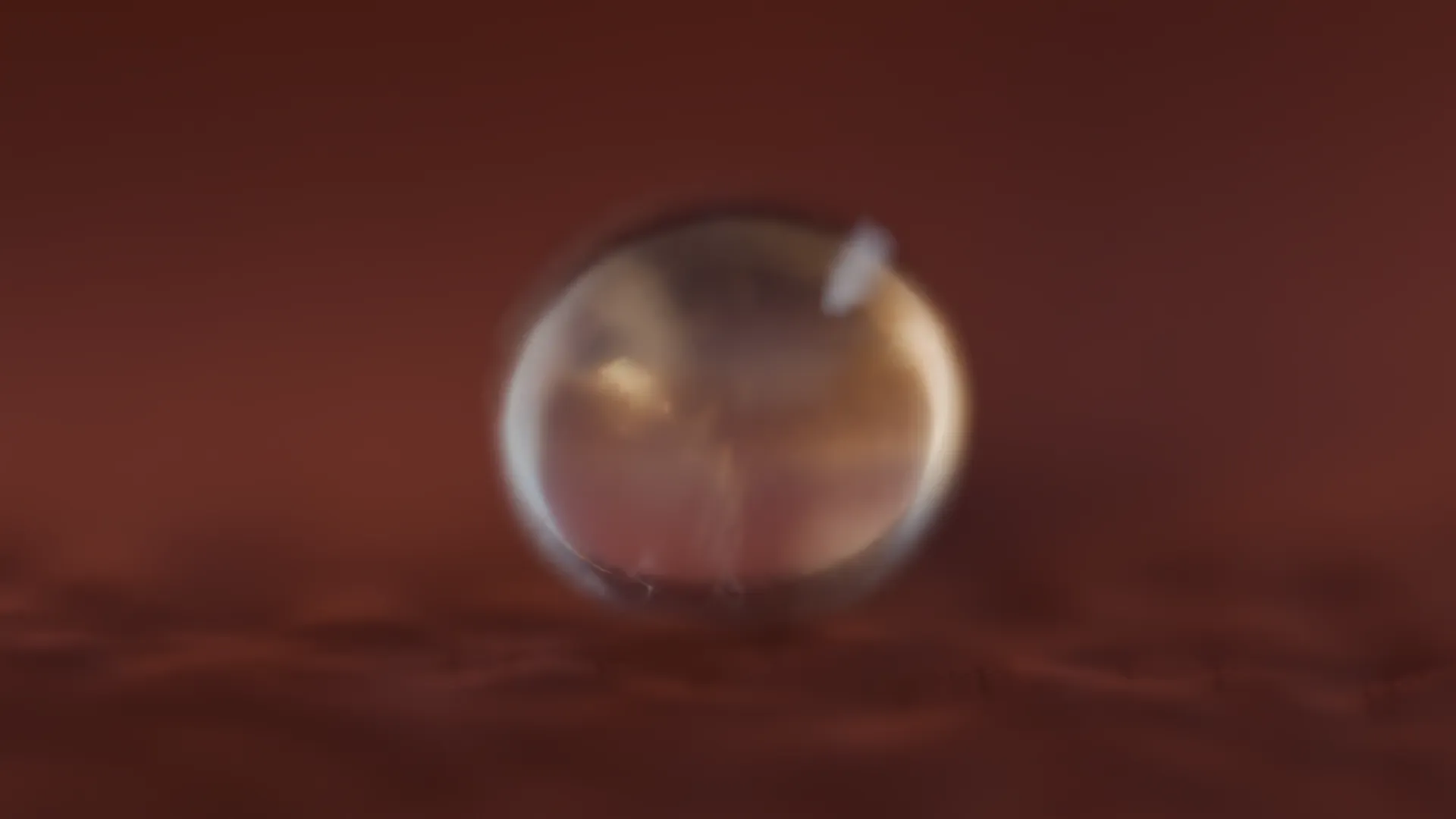
Closer still, the surface is made of tightly packed conical cells — the epidermis of the petal, where the rose makes and releases its scent.
A drop of dew lies across them like a lens. Above the surface, shown as a drifting shimmer, the scent molecules leave the petal for the air. (Rendered, and modeled where the eye cannot follow.)
One of them, β-damascenone, turns toward you. (Rendered, and modeled where the eye cannot follow.)

The chemistry

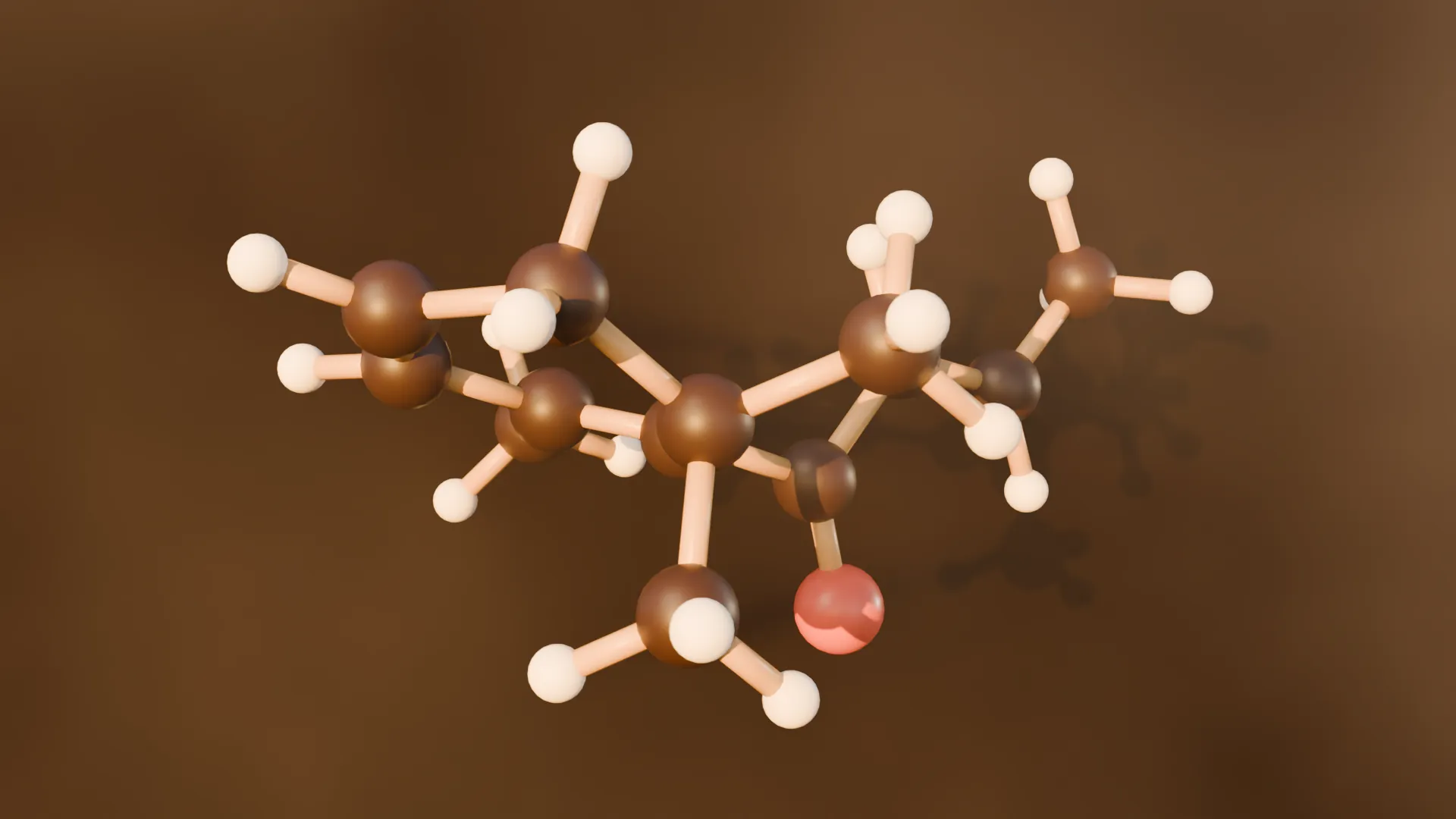
The chemistry of rose is breathtakingly complex — hundreds of identified compounds, each contributing to the accord. But the dominant olfactory force is β-Damascenone, which the nose notices at vanishingly small amounts (0.006 µg/kg in water).

The way back out: past the cells, the petal and the bloom to the field, and the field settles into its engraved plate.

The rose field at dawn, engraved again as the essay’s plate.
Transcript

The rose dive has no sound and no words. What it shows, in order:

  1. A field of roses at first light.
  2. One bloom, its petals still wet with dew.
  3. The upper surface of a petal, close enough to see its sheen.
  4. Closer still, the surface is made of tightly packed conical cells — the epidermis of the petal, where the rose makes and releases its scent.
  5. A drop of dew lies across them like a lens. Above the surface, shown as a drifting shimmer, the scent molecules leave the petal for the air. (Rendered, and modeled where the eye cannot follow.)
  6. One of them, β-damascenone, turns toward you. (Rendered, and modeled where the eye cannot follow.)
  7. The rose field at dawn, engraved again as the essay’s plate.

The way back out: past the cells, the petal and the bloom to the field, and the field settles into its engraved plate.

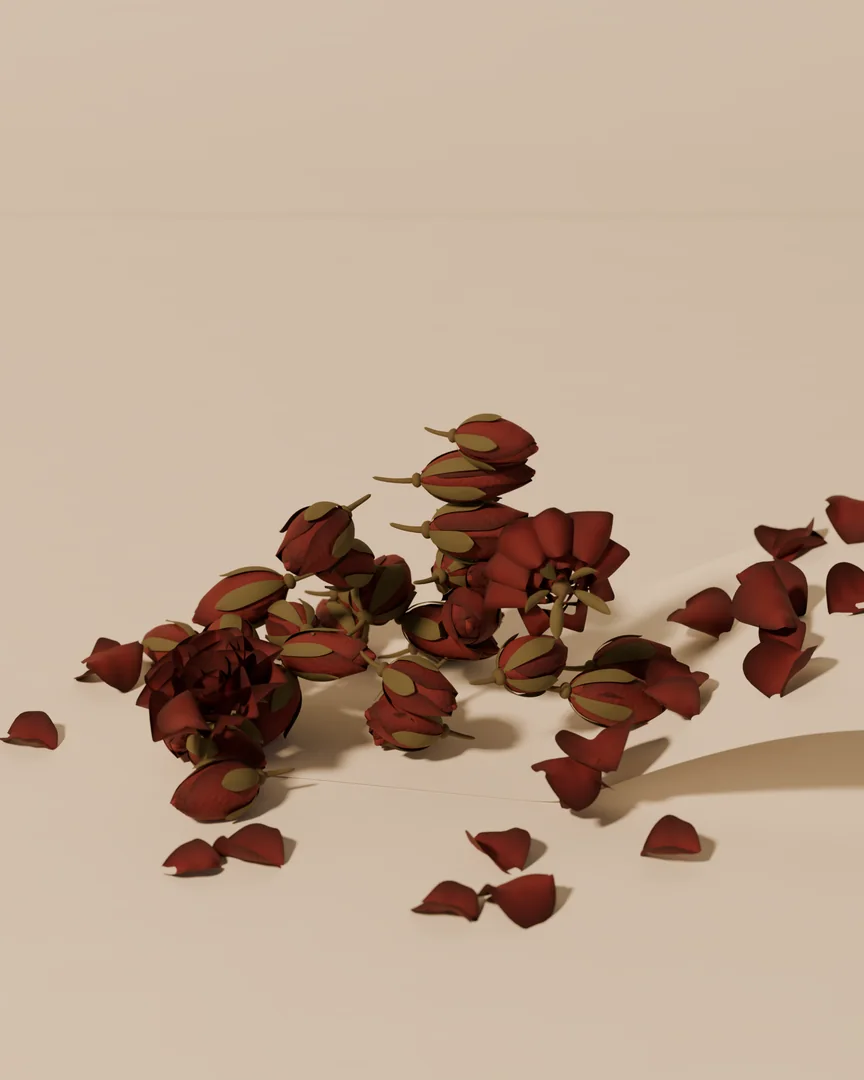
Dried damask rose buds heaped on an opened paper fold, a few loose curled petals around them
Specimen XA low heap of dried damask rose buds on an opened paper fold, two small dried heads tucked in, loose petals round its foot. Specimen modeled and rendered in-house, not a photograph. © Radler Parfums. See the render at full size (the rose specimen, 3072 × 3840 pixels)
Dominant Molecule β-Damascenone C₁₃H₁₈O · CAS 23696-85-7
Odor threshold
0.006 µg/kg in water
Picking season
20–30 days from May (PGI)

Fragrances built on this material Joy (Jean Patou, 1930)Nahéma (Guerlain, 1979)Rose Absolue (Annick Goutal)Portrait of a Lady (FM)Sa Majesté la Rose (Serge Lutens)

The record (rose absolute) · the record (rose otto: the picking)

Specimen I · Jasmine

Jasminum grandiflorum

Jasmine Absolute

The jasmine origin film: the jasmine rows of Tamil Nadu, closing on the plant, then a cut to the picked flowers on the bench
Film OR-1From the jasmine rows of Tamil Nadu to the picked flowers on the bench, scrubbed by your scroll. A reconstruction, modeled and rendered in-house, not footage of the place; its ground is a CC0 photo texture from Poly Haven. © Radler Parfums.
Transcript

The film has no sound and no words. What it shows, in order:

  1. The jasmine rows of Tamil Nadu, seen from low over the ground.
  2. The view moves in to one jasmine plant and closes on the part that is harvested.
  3. A cut to the picked flowers on a pale bench; the view pulls back to the specimen’s framing.
Jasminum grandiflorum, engraved botanical plate
Specimen IA loose mound of jasmine flowers and buds on the bench, settling into the house engraving. Specimen modeled and rendered in-house, not a photograph. © Radler Parfums. See the render at full size (the jasmine specimen, 3072 × 3840 pixels)
Tamil Nadu, India · 11.0°N · 79.0°EFlowering and harvest May–October · flowers for oil picked before 10 a.m.
documented

Season of flowering and harvest Flowering starts from May to October. Fully developed unopened flower buds are picked in the morning for fresh flower trade.

Tamil Nadu Agricultural University (TNAU), TNAU Agritech Portal, “Horticulture : · the source · read 2026-09-30

The crop guide gives the daily window only as “in the morning” for buds, and “before 10 a.m.” for opened flowers picked for oil.

the record

coordinates: Wikidata, a representative point · the recordrecord origin/tamil-nadu-in · version 4 · updated 2026-10-08 · the data

Jasmine absolute is a labor-intensive material. For oil the opened flowers are picked by hand early in the day — before 10 a.m., the Tamil Nadu crop guide says — and a great many of them go into a single gram of absolute. They cannot be steam-distilled without destroying their character. Solvent extraction, then alcohol washing, captures the full molecular complexity that makes jasmine simultaneously floral, narcotic, and faintly animalic.

The duality of indole — jasmine’s signature molecule — is one of perfumery’s great paradoxes. At high concentration it is objectively fecal. At the trace levels present in jasmine absolute, it produces the headily narcotic depth that makes white flowers so seductive. The same molecule at different scales produces entirely opposite olfactory experiences. This is the chemistry of jasmine’s scandalous reputation.

Key Molecule Indole C₈H₇N · CAS 120-72-9
Harvest time
Morning, before 10 a.m. (TNAU)
Process
Solvent extraction

Fragrances built on this material Joy (Jean Patou, 1930)Chanel No. 5À la Nuit (Serge Lutens)Dior J’adore

The record (jasmine absolute) · the concrete

Specimen II · Oud

Aquilaria malaccensis

Oud · Agarwood

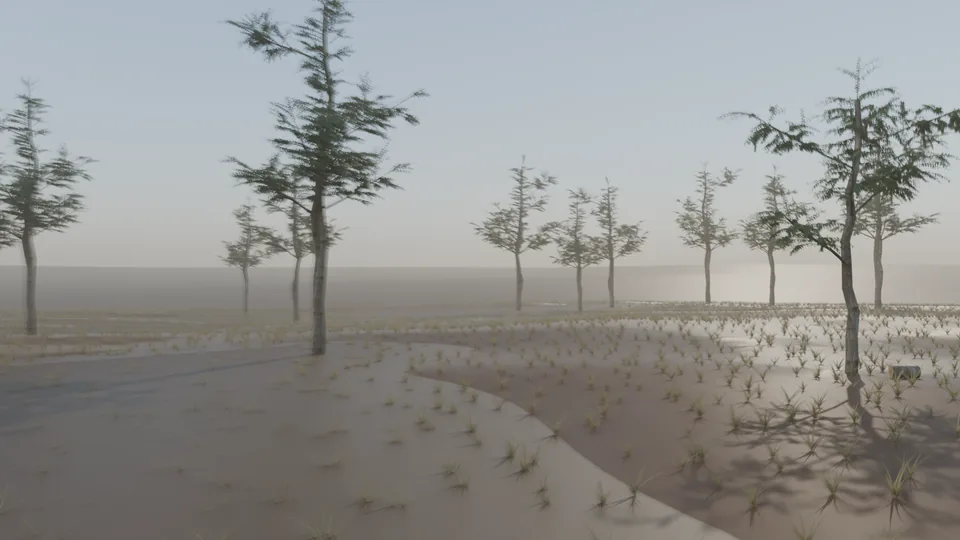
The oud origin film: the rainforest of Borneo and a felled agarwood log, closing on the plant, then a cut to the resinous chips on the bench
Film OR-2From the rainforest of Borneo and a felled agarwood log to the resinous chips on the bench, scrubbed by your scroll. A reconstruction, modeled and rendered in-house, not footage of the place; its ground and bark are CC0 photo textures from Poly Haven. © Radler Parfums.
Transcript

The film has no sound and no words. What it shows, in order:

  1. The rainforest of Borneo and a felled agarwood log, seen from low over the ground.
  2. The view moves in to one oud plant and closes on the part that is harvested.
  3. A cut to the resinous chips on a pale bench; the view pulls back to the specimen’s framing.
Agarwood (Aquilaria) chips streaked with resin, engraved plate
Specimen IIAgarwood chips with dark resinous streaks along the grain on the bench, settling into the house engraving. Specimen modeled and rendered in-house, not a photograph. © Radler Parfums. See the render at full size (the agarwood specimen, 3072 × 3840 pixels)
Sarawak, Malaysia · 2.5°N · 113.0°EHarvest season not stated here — no dated source yetcoordinates: Wikidata, a representative point · the recordrecord origin/sarawak-my · version 4 · updated 2026-10-14 · the data

Oud is not a product of the Aquilaria tree — it is its wound response. When the tree is wounded or infected by a fungus, it produces a dark, fragrant resin as a biological defense. This resin — called agarwood — can take decades to accumulate in sufficient quantity and quality. Long-aged pieces are among the costliest materials in perfumery.

Wild Aquilaria is now scarce and its trade is regulated. Much of today’s oud comes from cultivated trees in which the infection is induced by hand. Wild oud from Assam or Borneo, aged naturally over decades, remains among the costliest materials in perfumery, and the grades prized in Japan as kyara are rarer still.

Key Molecule Agarospirol C₁₅H₂₆O · CAS 1460-73-7
Trade
CITES Appendix II (the genus Aquilaria is listed)
Accumulation time
Decades
Origin
South-East Asia and India

Fragrances built on this material Oud Wood (Tom Ford)M7 (YSL, 2002)Oud Ispahan (Dior)Al Oudh (L’Artisan)Rose Oud (Kilian)

The record (agarwood oil)

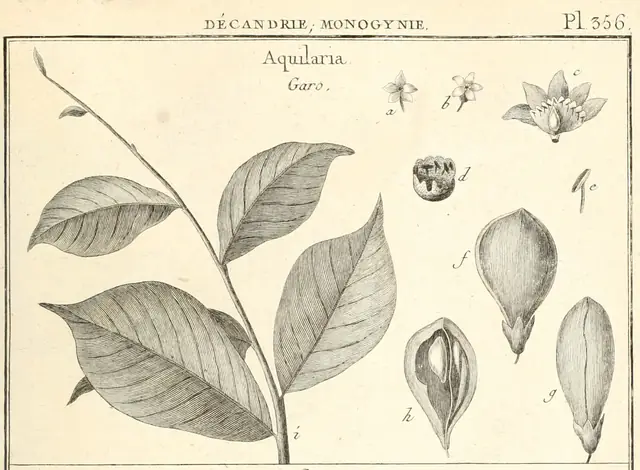
An engraved botanical plate headed Aquilaria, Garo: a branch with long, pointed, finely veined leaves on the left, and on the right small star-shaped flowers, a flower opened out, and the pear-shaped fruit drawn whole and cut open to show its seed.
Botanical plateAquilaria, “Garo” (Pl. 356, Décandrie, Monogynie) — Jean-Baptiste de Lamarck, Tableau encyclopédique et méthodique: Botanique; drawn by J. E. de Sève, engraved under Bénard, Paris, Panckoucke, 1791. University of Illinois Urbana-Champaign, via the Biodiversity Heritage Library (Internet Archive scan). Lamarck’s plate of the genus he named for the agarwood tree of Malacca, “Garo”: Aquilaria malaccensis. Public domain (Biodiversity Heritage Library): the Biodiversity Heritage Library record.

Specimen III · Lavender

Lavandula angustifolia

Fine Lavender

The lavender origin film: the lavender plateau of Haute-Provence, closing on the plant, then a cut to the dried sprigs on the bench
Film OR-3From the lavender plateau of Haute-Provence to the dried sprigs on the bench, scrubbed by your scroll. A reconstruction, modeled and rendered in-house, not footage of the place; its ground is a CC0 photo texture from Poly Haven. © Radler Parfums.
Transcript

The film has no sound and no words. What it shows, in order:

  1. The lavender plateau of Haute-Provence, seen from low over the ground.
  2. The view moves in to one lavender plant and closes on the part that is harvested.
  3. A cut to the dried sprigs on a pale bench; the view pulls back to the specimen’s framing.
Lavandula angustifolia, engraved plate
Specimen IIIDried lavender sprigs tied with jute on the bench, settling into the house engraving. Specimen modeled and rendered in-house, not a photograph. © Radler Parfums. See the render at full size (the lavender specimen, 3072 × 3840 pixels)
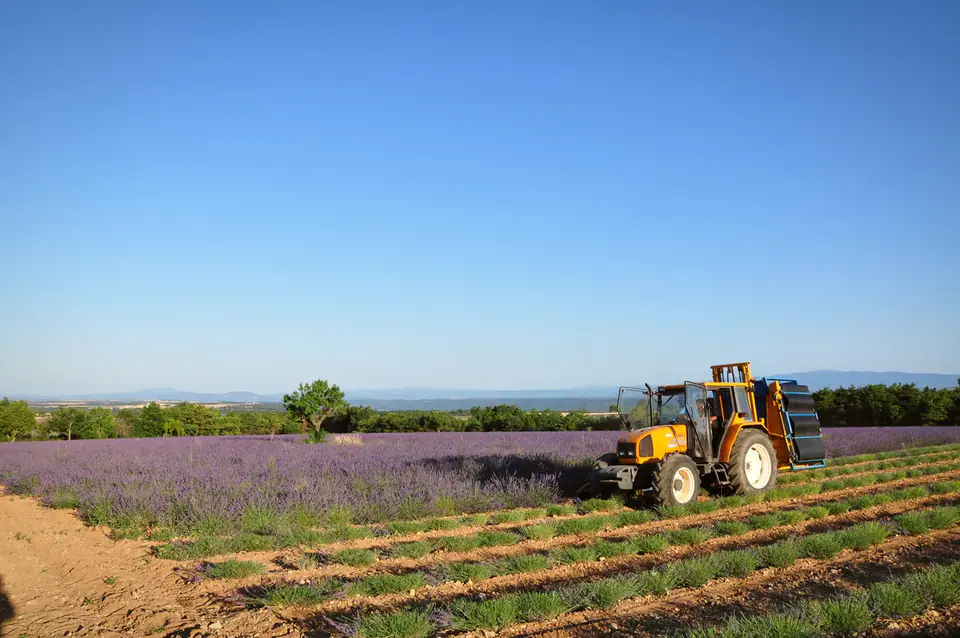
Alpes-de-Haute-Provence, France · 44.1°N · 6.2°EJuly to mid-August at altitude (Argens, Castellane) (fine lavender) · Mid-June to early July on the Valensole plateau (fine lavender) · From about 10 July to the end of July on the Valensole plateau (lavandin)
documented

En altitude, comme à Argens ou Castellane (Alpes-de-Haute-Provence) ou à Grasse (Alpes-Maritimes), la lavande est récoltée sur une période plus longue, du mois de juillet jusqu'à la mi-août.

Rosati-Marzetti C, anthropologist: “Les pratiques de culture des lavandes dans les Alpes-de-Haute-Provence”, Fiche… · the source · read 2026-09-30

The source says « la lavande », a word it uses for lavender in general; at Argens the crop is fine lavender.

the record

coordinates: Wikidata, a representative point · the recordrecord origin/alpes-de-haute-provence-fr · version 4 · updated 2026-10-08 · the data

True fine lavender (as opposed to lavandin, its more robust hybrid) is cultivated above 800 m on the limestone plateaux of Haute-Provence, inside the AOC area. The altitude and thin soil produce a higher proportion of linalyl acetate — the ester that gives fine lavender its refined, slightly sweet quality — versus linalool, which the house reads as sharper and more medicinal.

The distinction between Lavandula angustifolia and Lavandula × intermedia (lavandin) is commercially significant. Fine lavender is rarer and more expensive; lavandin gives almost three times as much essential oil as fine lavender, and a good deal of what is sold as “lavender” is lavandin. The gas chromatography of each is distinct and unmistakable to a trained analyst.

Key Molecule Linalool C₁₀H₁₈O · CAS 78-70-6
Altitude
Above 800 m (the AOC area)
Natural sources
Many plant species
Harvest
Mid-June to early July on the Valensole plateau; July to mid-August higher up (Ministry of Culture record)

Fragrances built on this material Pour un Homme (Caron, 1934)Jicky (Guerlain, 1889)English Lavender (Yardley)Drakkar Noir (Guy Laroche)Habit Rouge (Guerlain)

The record (lavender essential oil) · lavandin

Specimen IV · Sandalwood

Mysore Sandalwood

Woody · Santalum album

The sandalwood origin film: the dry scrub of Mysore, closing on the plant, then a cut to the split heartwood on the bench
Film OR-4From the dry scrub of Mysore to the split heartwood on the bench, scrubbed by your scroll. A reconstruction, modeled and rendered in-house, not footage of the place; its ground and bark are CC0 photo textures from Poly Haven.
Transcript

The film has no sound and no words. What it shows, in order:

  1. The dry scrub of Mysore, seen from low over the ground.
  2. The view moves in to one sandalwood plant and closes on the part that is harvested.
  3. A cut to the split heartwood on a pale bench; the view pulls back to the specimen’s framing.
Santalum album, engraved plate
Specimen IVA split half-billet of sandalwood heartwood with shavings and chips on the bench, settling into the house engraving. Specimen modeled and rendered in-house, not a photograph. © Radler Parfums. See the render at full size (the sandalwood specimen, 3072 × 3840 pixels)
Mysore, Karnataka, India · 12.3°N · 76.7°EHarvest season not stated here — no dated source yetcoordinates: Wikidata, a representative point · the recordrecord origin/mysore-in · version 3 · updated 2026-10-01 · the data

The heartwood of decades — a prized wood in perfumery, its creamy, milky sweetness hard to match with any synthetic or other species.

Mysore sandalwood comes from Karnataka, India. The Santalum album tree is a hemiparasite — it must attach its roots to host trees to survive. The fragrant heartwood takes decades to develop, and harvest in India is tightly regulated. The scarcity makes genuine Mysore sandalwood oil one of the costliest materials in perfumery.

Alternative species exist — Australian (Santalum spicatum) and Hawaiian (Santalum paniculatum) — but connoisseurs consider them inferior. Mysore oil is rich in α-santalol, the source of its creaminess. The wood was sacred in Hindu and Buddhist tradition for millennia; carved sandalwood keeps its scent for a very long time.

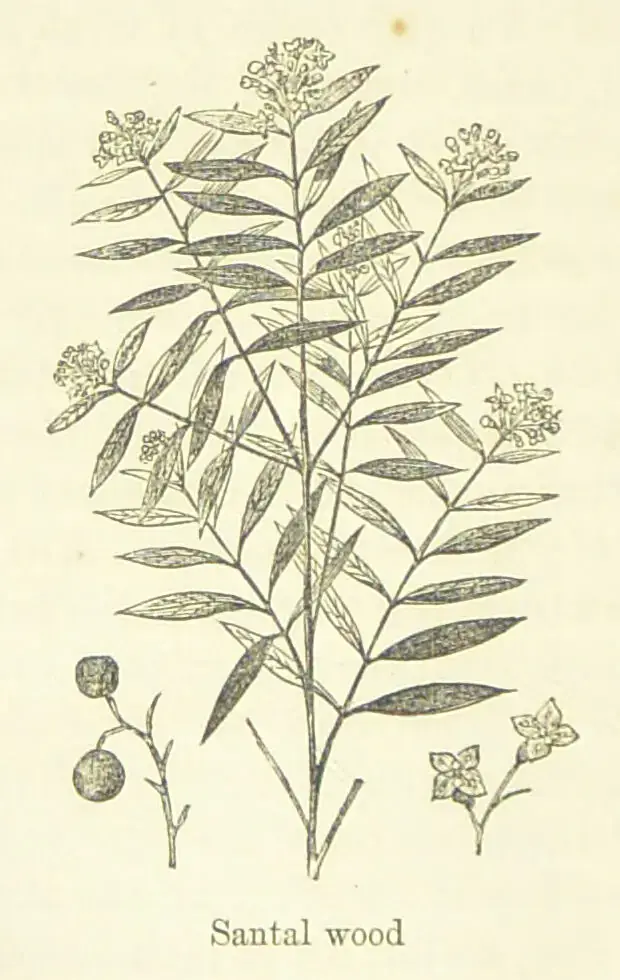
A book engraving of a branch of the sandalwood tree with narrow paired leaves and small clustered flowers, a fruit and a flower drawn apart at its foot, above the printed caption Santal wood.
Wellcome Collection · book“Santal wood”, from The Art of Perfumery — George William Septimus Piesse, 1862. Wellcome Collection, London. Page 138, where Piesse writes that santal wood is burned in the religious ceremonies of the Brahmins, Hindus and Chinese. Public Domain Mark (Wellcome Collection): the Wellcome Collection record.
Principal molecule α-Santalol
Tree maturity
Decades
α-Santalol
With β-santalol, the main contributor to the scent
Extraction
Steam distillation

The record (sandalwood oil)

Specimen V · Vetiver

Haitian Vetiver

Earthy · Chrysopogon zizanioides

The vetiver origin film: a vetiver hillside in Haiti, closing on the plant, then a cut to the washed roots on the bench
Film OR-5From a vetiver hillside in Haiti to the washed roots on the bench, scrubbed by your scroll. A reconstruction, modeled and rendered in-house, not footage of the place; its ground is a CC0 photo texture from Poly Haven. © Radler Parfums.
Transcript

The film has no sound and no words. What it shows, in order:

  1. A vetiver hillside in Haiti, seen from low over the ground.
  2. The view moves in to one vetiver plant and closes on the part that is harvested.
  3. A cut to the washed roots on a pale bench; the view pulls back to the specimen’s framing.
Chrysopogon zizanioides vetiver root, engraved plate
Specimen VA bundle of fine vetiver roots tied at the crown on the bench, settling into the house engraving. Specimen modeled and rendered in-house, not a photograph. © Radler Parfums. See the render at full size (the vetiver specimen, 3072 × 3840 pixels)
Haiti · 19.0°N · 72.8°WHarvest season not stated here — no dated source yetcoordinates: Wikidata, a representative point · the recordrecord origin/haiti-ht · version 3 · updated 2026-10-01 · the data

The oil of the earth — smoky, rooty, ancient. Extracted from the roots of a humble grass, vetiver anchors many celebrated fragrances.

Vetiver is a tall, perennial grass native to India but cultivated worldwide. The oil comes not from leaves or flowers but from roots — dense, tangled networks that must be carefully washed and distilled. Haitian vetiver is prized for its depth and smokiness; Javanese and Réunion versions are cleaner but lack the complexity.

Haiti is one of the leading producers of vetiver oil, and the crop supports a great many small farmers. With about two hundred compounds on record, vetiver is a chemically complex natural material. Khusimol is among its most abundant alcohols, but the smell itself has been traced to a trace ketone, and the full orchestra creates the unmistakable character.

Principal molecule Khusimol
Part used
Roots
Compounds
About two hundred on record
Distillation
Long, slow distillation

The record (vetiver oil)

Specimen VI · Frankincense

Omani Frankincense

Resinous · Boswellia sacra

The frankincense origin film: a limestone wadi in Dhofar, closing on the plant, then a cut to the resin tears on the bench
Film OR-6From a limestone wadi in Dhofar to the resin tears on the bench, scrubbed by your scroll. A reconstruction, modeled and rendered in-house, not footage of the place; its ground and bark are CC0 photo textures from Poly Haven. © Radler Parfums.
Transcript

The film has no sound and no words. What it shows, in order:

  1. A limestone wadi in Dhofar, seen from low over the ground.
  2. The view moves in to one frankincense plant and closes on the part that is harvested.
  3. A cut to the resin tears on a pale bench; the view pulls back to the specimen’s framing.
Boswellia sacra frankincense, engraved plate
Specimen VITranslucent frankincense resin tears on the bench, settling into the house engraving. Specimen modeled and rendered in-house, not a photograph. © Radler Parfums. See the render at full size (the frankincense specimen, 3072 × 3840 pixels)
Dhofar, Oman · 18.0°N · 54.0°EHarvest season not stated here — no dated source yetcoordinates: Wikidata, a representative point · the recordrecord origin/dhofar-om · version 3 · updated 2026-10-01 · the data

The sacred smoke of millennia — burned in temples, frankincense links modern perfumery to aromatic traditions thousands of years old.

Frankincense is the hardened resin (tears) of Boswellia trees, harvested by making incisions in the bark. The Dhofar region of Oman produces Boswellia sacra. The Hojari grade (silvery-green tears from high altitude) commands premium prices. Ancient Egyptians burned it in temples; the Magi brought it to Bethlehem; it remains central to Orthodox Christian liturgy.

The scent is lemony, piney, balsamic with an unmistakable sacred smokiness. Laboratory studies in animals have reported effects of incensole acetate, a compound in the resin; what that means for people burning it is not established. Steam distillation yields the essential oil; CO₂ extraction captures a more complete profile.

Key compound Incensole acetate
Top grade
Hojari (Oman)
Sacred use
Thousands of years
Harvest method
Bark incisions
Extraction
Steam / CO₂

The record (frankincense resin)

Specimen VII · Bergamot

Calabrian Bergamot

Citrus · Citrus bergamia

The bergamot origin film: the bergamot groves of Calabria, closing on the plant, then a cut to the fruit on the bench
Film OR-7From the bergamot groves of Calabria to the fruit on the bench, scrubbed by your scroll. A reconstruction, modeled and rendered in-house, not footage of the place; its ground and bark are CC0 photo textures from Poly Haven. © Radler Parfums.
Transcript

The film has no sound and no words. What it shows, in order:

  1. The bergamot groves of Calabria, seen from low over the ground.
  2. The view moves in to one bergamot plant and closes on the part that is harvested.
  3. A cut to the fruit on a pale bench; the view pulls back to the specimen’s framing.
Citrus bergamia bergamot, engraved plate
Specimen VIITwo bergamot fruits on a citrus leaf on the bench, settling into the house engraving. Specimen modeled and rendered in-house, not a photograph. © Radler Parfums. See the render at full size (the bergamot specimen, 3072 × 3840 pixels)
Calabria, Italy · 39.0°N · 16.5°EHarvest season not stated here — no dated source yetcoordinates: Wikidata, a representative point · the recordrecord origin/calabria-it · version 4 · updated 2026-10-01 · the data

The sunshine citrus of southern Italy — bright, aromatic, distinctive. Bergamot opens much of classical perfumery, from the early colognes to Chanel No. 5.

Bergamot is a small, bitter citrus fruit grown mainly in the Calabria region of southern Italy, along a narrow coastal strip. Its microclimate — Mediterranean sun, the soil, coastal humidity — is hard to match elsewhere, and Calabria is the source most often named for bergamot oil.

The oil is cold-pressed from the peel, preserving delicate aromatic compounds that heat would destroy. Raw bergamot contains bergapten, a furanocoumarin that can make skin sensitive to sunlight — which is why perfumery generally uses bergapten-free (FCF) grades. The scent is simultaneously citrusy, floral, and slightly spicy — more complex than lemon or orange, more sophisticated than grapefruit. It provides the sparkling top note for countless classics.

Principal molecule Linalyl acetate
Calabria
The source most often named
Extraction
Cold expression

The record (bergamot essential oil)

Specimen VIII · Vanilla

Madagascar Vanilla

Gourmand · Vanilla planifolia

The vanilla origin film: a vanilla plantation in Madagascar, closing on the plant, then a cut to the cured pods on the bench
Film OR-8From a vanilla plantation in Madagascar to the cured pods on the bench, scrubbed by your scroll. A reconstruction, modeled and rendered in-house, not footage of the place; its ground and bark are CC0 photo textures from Poly Haven. © Radler Parfums.
Transcript

The film has no sound and no words. What it shows, in order:

  1. A vanilla plantation in Madagascar, seen from low over the ground.
  2. The view moves in to one vanilla plant and closes on the part that is harvested.
  3. A cut to the cured pods on a pale bench; the view pulls back to the specimen’s framing.
Vanilla planifolia, engraved plate
Specimen VIIIFive cured vanilla pods on the bench, settling into the house engraving. Specimen modeled and rendered in-house, not a photograph. © Radler Parfums. See the render at full size (the vanilla specimen, 3072 × 3840 pixels)
Madagascar · 20.0°S · 47.0°EHarvest season not stated here — no dated source yetcoordinates: Wikidata, a representative point · the recordrecord origin/madagascar-mg · version 3 · updated 2026-10-01 · the data

The warm, sweet heart of the gourmand family. A labor-intensive spice: each flower pollinated by hand on the single day it is open.

Vanilla is an orchid, and its fruit is the vanilla pod. Native to Mexico, it was transplanted to Madagascar by French colonists in the 19th century. The island is now one of the leading growers of vanilla. Outside Mexico, no native pollinator exists — every flower must be hand-pollinated by workers using thin sticks, during the brief morning window when the flower is receptive.

Green vanilla pods are odorless; the characteristic scent develops only through months of curing — blanching, sweating, drying, conditioning. Vanillin is the dominant aromatic compound, but natural vanilla contains hundreds of compounds that give it depth synthetic vanillin cannot match. Much of the world’s vanilla is grown in Madagascar and sold as Bourbon vanilla (named after Île Bourbon, the old name of Réunion), for perfumery and cuisine alike.

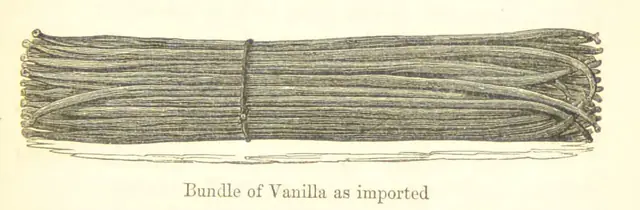
A book engraving of a long, flat bundle of vanilla pods laid side by side and tied around the middle, above the printed caption Bundle of Vanilla as imported.
Wellcome Collection · book“Bundle of Vanilla as imported”, from The Art of Perfumery — George William Septimus Piesse, 1862. Wellcome Collection, London. Page 149 of the 1862 edition: the pods as the trade received them, after curing, tied in a bundle. Public Domain Mark (Wellcome Collection): the Wellcome Collection record.
Principal molecule Vanillin
Madagascar
A leading grower
Pollination window
The single day the flower is open
Curing time
Months
Aroma compounds
Formed during curing

The record (cured vanilla pods)

1 unsourced

Specimen IX · Iris

Florentine Iris

Floral · Iris pallida

The iris origin film: a Tuscan hillside at the iris harvest, closing on the plant, then a cut to the dried rhizome on the bench
Film OR-9From a Tuscan hillside at the iris harvest to the dried rhizome on the bench, scrubbed by your scroll. A reconstruction, modeled and rendered in-house, not footage of the place; its ground, and the bark of the olive trees on the far edge of the field, are CC0 photo textures from Poly Haven. © Radler Parfums.
Transcript

The film has no sound and no words. What it shows, in order:

  1. A Tuscan hillside at the iris harvest, seen from low over the ground.
  2. The view moves in to one iris plant and closes on the part that is harvested.
  3. A cut to the dried rhizome on a pale bench; the view pulls back to the specimen’s framing.
Iris pallida orris, engraved plate
Specimen IXPieces of peeled, dried orris rhizome on the bench, settling into the house engraving. Specimen modeled and rendered in-house, not a photograph. © Radler Parfums. See the render at full size (the orris specimen, 3072 × 3840 pixels)
Florence, Italy · 43.8°N · 11.3°EHarvest season not stated here — no dated source yetcoordinates: Wikidata, a representative point · the recordrecord origin/florence-it · version 3 · updated 2026-10-01 · the data

The powdery elegance of orris root — among the costliest natural materials in perfumery. Years of aging transform buried rhizomes into olfactory gold.

The fragrance comes not from iris flowers but from the rhizomes (roots), called orris root. After harvest, the roots must be peeled, dried, and aged for several years — during this time, iridals in the rhizome degrade by oxidation into irones, the precious ketones that give orris its powdery, violet-like character. Iris pallida is the basis of industrial orris in Tuscany, where irises have a long tradition as a crop; Italy was once the hallmark of orris production, and today it is grown mainly around Chianti and Pratomagno.

Orris butter — the steam-distilled oil, also called orris concrete — is produced after aging, and orris absolute is made from it. Orris butter is among the costliest materials any perfumer will ever handle. The scent is powdery, cool, elegant — refined and restrained. Synthetic irones (like Orris Givco) exist but cannot match the complexity of the natural. Florentine orris remains hard to replace in haute perfumery.

Principal molecule α-Irone
Aging time
Several years
Part used
Rhizomes (roots)
Key compound
α-Irone

The record (orris butter)

1 labeled

Help bring a GC-MS lab and free classes to the guide. why?