Act III · Heart · The Library
The Library
Tools, calculators, simulators, the fragrance wheel and the industry reference: the hands-on and encyclopedic side of the house.


Reference & tools
The hands-on and encyclopedic material, gathered in one place — calculators, simulators, the fragrance wheel, guides, and the industry reference. The house proper lives under Materials, Science, History, and the Atelier.

1 labeled
Evidence for this section: 1 labeled
The Library in four chapters

The Instruments

Wearing Perfume
The Reference Shelf

The Trade
Batch Code Decoder
Most bottles carry a production code. Where two or more independent public sources agree on how a maker writes its code, or codes with dates printed beside them support it, the decoder reads it and shows each step; where they do not, it says so and guesses nothing. Only the house can date a code for certain or confirm a bottle.
The decoder has its own page. It covers 59 brands from 49 makers: for each, what is publicly documented about its code, where the code is, what cannot be told, and the sources. 12 makers have a format it reads (7 at B, 5 at C), each as a date range with its confidence; 2 print a date on the pack; for the rest it says what is not known rather than guessing.
Estimates from public batch-code conventions; not affiliated with any brand; formats can change.
What collectors check
2 labeled
Evidence for this section: 2 labeled
Perfumery Glossary
The precise language of fragrance — from the bench to the bottle. Thirty-seven terms in alphabetical order; the cabinet has a drawer for thirty-six.
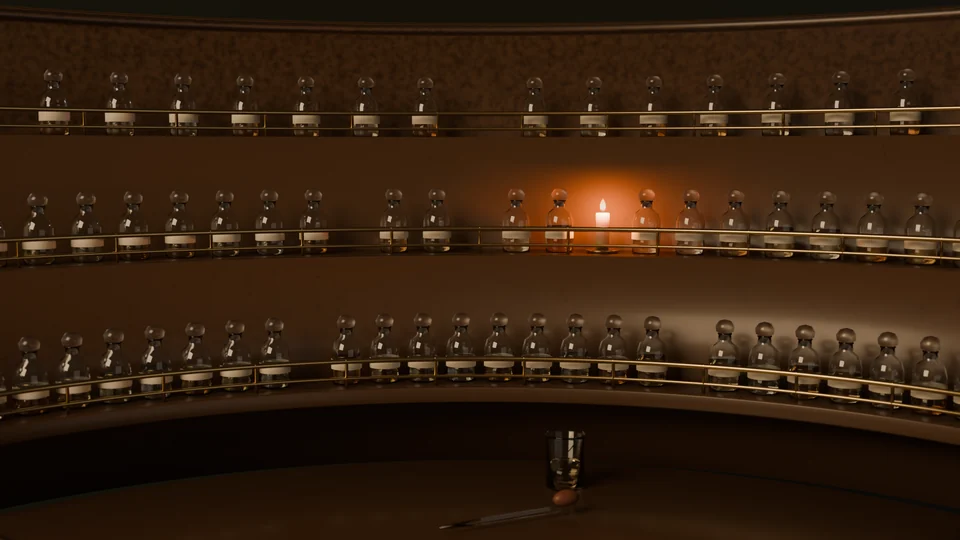
See the cabinet rendered in-house, at full size (Plate CAB-1, 2560 × 1440 pixels)
37 terms
Jump to A B C D E F H I L M N O P R S T V
- Absolute
- A highly concentrated aromatic extract obtained through solvent extraction, then alcohol washing. More complete than a distilled essential oil — captures compounds that heat would destroy, including jasmine’s most characteristic olfactory molecules.
- Accord
- A balanced blend of notes that creates a new, unified scent impression — like a musical chord, where the individual instruments disappear into something greater than their sum.
- Aldehydes
- A class of organic compounds that add sparkle, lift, and a waxy-soapy quality at low concentrations. Defined the 1920s aesthetic. Chanel No. 5 is the famous early example of using them at full creative effect — and it redrew what a floral could be.
- Anosmia
- The inability to detect a specific odor molecule. Some people cannot smell Iso E Super, or smell it only faintly. Anosmia is receptor-specific — someone anosmic to one molecule may have exceptional sensitivity to another. It is more common than people tend to assume.
- Attar
- Traditional oil-based perfume from the Middle East and South Asia. Made by distilling botanical materials into a sandalwood oil base using the deg-bhapka method. Alcohol-free, highly concentrated, and extraordinarily long-lasting. The Kannauj region of India is the traditional center.
- Bakhoor
- Traditional Arabian incense made from wood chips soaked in fragrant oils, then burned on charcoal. The smoke scents homes, clothes, and hair. Central to Gulf hospitality culture. Oud, sandalwood, and amber oils are traditional; the practice dates back millennia.
- Brief
- The document a brand provides to perfumers describing what they want: target demographic, price point, competitive positioning, desired mood/character. Professional perfumery is almost always commercial — the art lives within the constraints the brief defines.
- Captive
- A proprietary aroma chemical owned exclusively by a single fragrance house (Givaudan, Firmenich (now DSM-Firmenich), IFF, Symrise). Captives are protected as trade secrets and by patent, so competitors may not freely use them. Many well-known notes (Calone, Javanol, Hedione HC) began as captives.
- Chypre Structure
- A tripartite accord: bergamot (bright top) + floral heart + oakmoss/labdanum base. A demanding structure to balance. IFRA’s restrictions on oakmoss have altered the modern chypre — many argue the category no longer truly exists.
- Concrete
- A waxy, solid aromatic material obtained from initial solvent extraction, before alcohol washing yields the absolute. Concretes retain waxes and non-aromatic plant material alongside the valuable aromatic compounds.
- Dry Down
- The final phase of a fragrance’s evolution on skin, when top and heart notes have faded. The dry-down is the fragrance’s true character — and an honest test of its quality and compatibility with your chemistry.
- Enfleurage
- The ancient technique of extracting fragrance by pressing flowers into odorless fats. The scented fat (pomade) is later washed with alcohol. Almost extinct commercially due to labor intensity, but still practiced by artisan houses. Produces especially “alive” floral extracts.
- Evaluator
- The professional at a fragrance house who reviews submissions from perfumers, provides feedback, and decides which formulas progress toward the client. Evaluators bridge creative and commercial — understanding both artistry and market requirements.
- Fixative
- A material that slows the evaporation of more volatile components, extending a fragrance’s longevity. Traditional fixatives include benzoin, labdanum, and ambergris. Modern synthetics like ethylene brassylate and iso e super serve similar functions while adding their own character.
- Fougère
- French for “fern” — a fragrance family built on lavender, coumarin, and oakmoss. The scent of fern doesn’t exist in nature; it’s purely a perfumery construct. Fougère Royale (1882 or 1884) set the structure, which became a common masculine architecture for over a century.
- Headspace
- A technology that captures the volatile compounds surrounding a living object — flowers, forests, even cities. Sensors analyze the “headspace” above the subject, creating molecular maps that perfumers can attempt to recreate. Allows capture of scents that cannot be extracted.
- IFRA
- International Fragrance Association — the self-regulatory body that sets safety guidelines for fragrance ingredients. IFRA Standards (the industry’s own rules, not law in the US) limit or prohibit certain materials, and have reshaped modern perfumery, sometimes controversially. Its restrictions on oakmoss particularly altered chypre compositions.
- Indolic
- Describing florals that contain indole — a molecule present in jasmine, tuberose, orange blossom, and gardenia. At trace levels, indole adds lushness and sensuality. At high levels, it becomes fecal. Indolic florals have a narcotic, heady quality absent from non-indolic flowers like rose.
- Ionones
- A family of compounds responsible for violet character. Alpha-isomethyl ionone is the workhorse of violet accords. Ionones are derived from citral through ring-closure reactions. They provide powdery, orris-like character at a fraction of orris root’s cost.
- Lactones
- Cyclic esters that often provide creamy, milky, or fruity notes. Coumarin (an early synthetic aromatic, 1868) is a lactone. The gamma and delta-lactones contribute peach, coconut, and milky qualities. Massoia lactone (from massoia bark) provides coconut character.
- Linear
- A fragrance that smells essentially the same from first spray to dry-down, without significant evolution. Often achieved through synthetic-heavy compositions. Can be reliable and consistent but potentially less interesting than evolutionary compositions that transform over time.
- Maceration
- The aging process where a perfume concentrate rests in alcohol — weeks to months — allowing molecules to bind and harmonize into a unified accord. Industrial fragrances skip this. Great fragrances do not.
- Macrocyclic Musks
- Large-ring molecules (15+ atoms) that smell musky, clean, and skin-like. Muscone is the natural archetype. Synthetics include habanolide, ethylene brassylate, and cosmone. They are often used in place of the nitro-musks and some polycyclic musks, which raised safety and environmental concerns.
- Mouillette
- The paper scent strip perfumers use for evaluation. Proper technique: dip, wave gently to evaporate alcohol, bring to nose at 45° angle. Never sniff directly from bottles — you’ll fatigue receptors and miss the evolution. Professional evaluation tracks how the strip changes over hours.
- Niche
- Independent fragrance houses focused on artistic expression over mass appeal, typically at higher price points. The line between niche and designer has blurred — major corporations own many “niche” brands, and some designers produce artistically ambitious fragrances.
- Nose
- A master perfumer, trained to identify and compose with hundreds of raw materials — often across decades. Celebrated noses include Edmond Roudnitska, Jean-Claude Ellena, Francis Kurkdjian, and Nathalie Gracia-Cetto.
- Olfactory Fatigue
- The temporary inability to smell a particular odor after prolonged exposure — your brain stops registering a constant stimulus. Why you “can’t smell your own perfume” after an hour. Professional perfumers step outside between evaluations. The coffee beans on the counter are meant as a reset, but a small 2011 study found them no better than plain air (Grosofsky and colleagues, Perceptual and Motor Skills).
- Orris
- The rhizome (root) of the iris flower, dried for a few years to develop its powdery, violet-like character. Orris butter is a costly natural material. The irone compounds responsible for the scent develop only through oxidation during aging.
- Oud
- In the Aquilaria tree, the heartwood, where a dark fragrant resin forms when the tree is wounded or infected by a fungus. Revered in Middle Eastern and Asian perfumery for millennia. Genuine oud is among the costliest materials in perfumery; much of the “oud” in Western perfumery is built from other materials (cypriol, Javanol, oud bases). The real thing is dark, complex, and often animalic.
- Ozonic
- Describing the fresh, clean, slightly metallic scent of air after a thunderstorm — ozone itself. Achieved primarily through Calone (sea breeze/watermelon) and helional (fresh air/marine). The ozonic category was impossible before synthetic chemistry; nature provides no extractable equivalents.
- PGI
- Protected Geographical Indication: an EU registration for a product’s name, not a grade of quality. The name must identify a product from a defined place, region or country, owe its quality, reputation or another characteristic essentially to that origin, and have at least one step of its production carried out there (Regulation (EU) No 1151/2012, Article 5(2); since 2024 Regulation (EU) 2024/1143, which kept the names already registered). Bulgarian rose oil, “Bulgarsko rozovo maslo”, has been a PGI since 2014. Under a PGI, only producers who follow the registered specification may use the name.
- Projection
- How far a fragrance radiates from your skin into the surrounding space. Related to but distinct from sillage. High projection means the scent extends outward actively; low projection (skin scent) requires close proximity. Neither is inherently better — context determines appropriateness.
- Reformulation
- The process of altering a fragrance’s formula — often due to IFRA restrictions, cost pressures, or ingredient availability. Reformulations are rarely announced. Enthusiasts debate whether vintage formulas are genuinely superior or just remembered through nostalgia’s filter.
- Sillage
- French for “wake” — the scent trail a fragrance leaves behind as you move through space. High sillage announces entry; low sillage stays intimate, a secret between wearer and close recipient.
- Soliflore
- A fragrance that focuses on a single flower — rose, jasmine, lily of the valley. The goal is realistic representation rather than abstract composition. Creating a convincing soliflore is surprisingly difficult; natural materials alone rarely capture the full flower experience.
- Terpenes
- A vast class of naturally occurring organic compounds in fragrance. Built from isoprene units (C₅H₈) — monoterpenes (C₁₀), sesquiterpenes (C₁₅), diterpenes (C₂₀). Linalool, limonene, pinene, and santalol are all terpenoids. They define the character of most natural aromatic materials.
- Vapor Pressure
- The physical property that determines where a material sits in the fragrance pyramid. High vapor pressure = top note (evaporates quickly). Low vapor pressure = base note (persists for hours). It is the fundamental physics of fragrance architecture.
No term matches that search.