Act IV · Colophon
Credits & Provenance
What the house made itself, every third-party model and image with its author, license and link, and the open tools it was built on.
About 8 minutes of reading

Made in-house
Almost everything you see here — the engravings, the house’s own engraved plates, the wordmark and the interactive 3D objects — was made in-house for Radler Parfums. Anything that is not ours is named here with its author and license. Today that means the third-party 3D models credited below: the rose and the copper still in the films, the models from open collections that you can place in your room, and a few public-domain (CC0) textures and light maps used in our renders; and the public-domain prints, paintings, botanical plates, pages of old books, early photographs and museum objects from open collections, each captioned where it appears with the rights statement its museum or library gives; and the photographs of the materials from Wikimedia Commons, each credited under the photograph with its author and license. Both are listed, image by image, on pages of their own: images from open collections and photographs of the materials. This page lists what the house made itself, those models, and the open tools the site was built on.
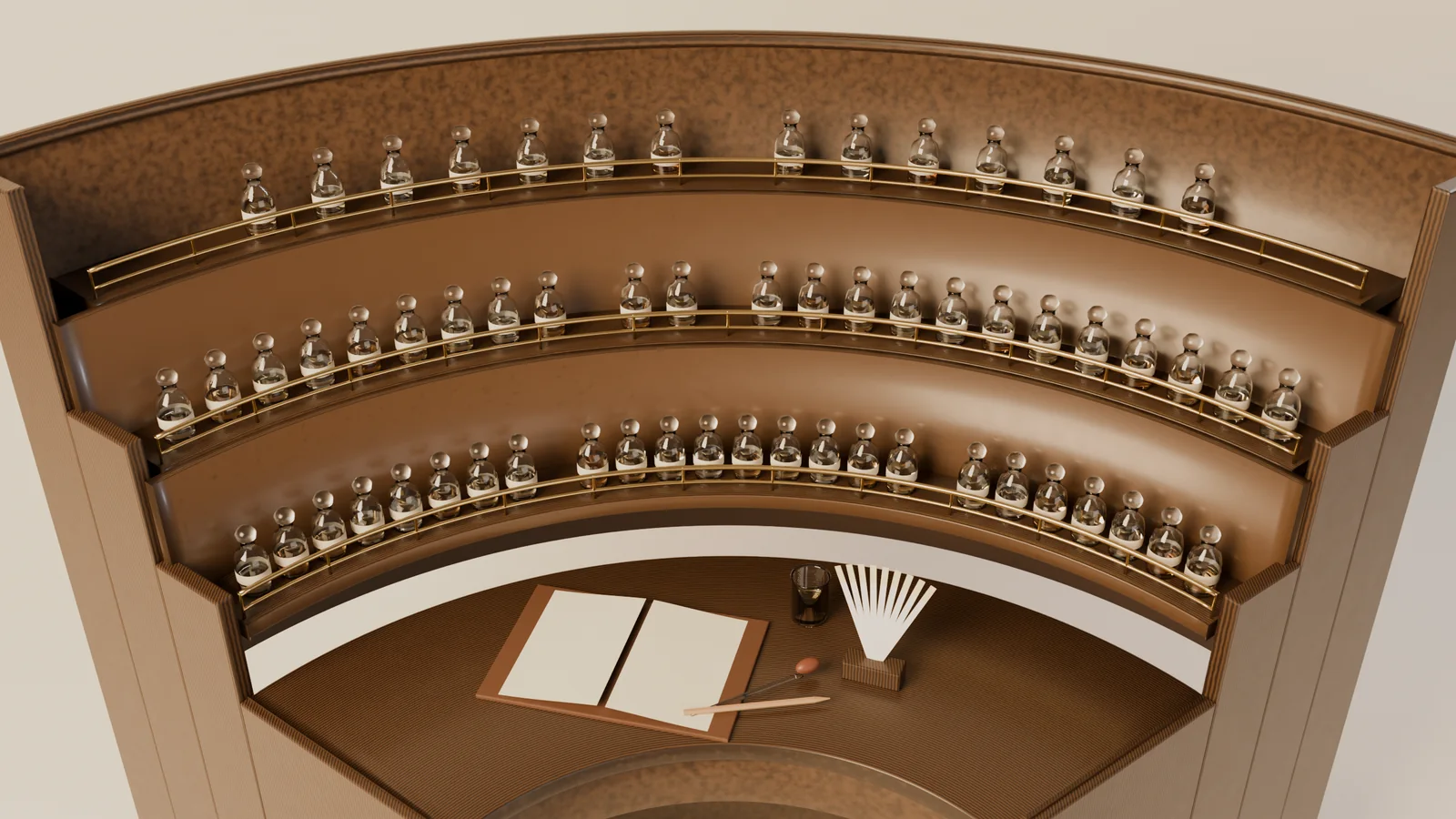
The home page opens on an in-house film: an engraved copper still, rendered in Blender (Cycles) at 1920×1080. The rose dive on the Materials page is rendered the same way, and so are the still lifes in natural light on the station pages and the material records (the still room, the bench, the solvent bench, the organ, the cabinet and the specimen portraits). The interactive 3D objects — the copper alembic you can turn on the Science page, the flacons on the History page, and some of the models offered in augmented reality — were modeled in-house in Blender with physically-based materials; the others are credited below. The globe, the orrery and the other engraved plates are drawn in the browser from the house’s own data. The models credited below are not ours: two in the films and the others from open collections, each with its license. No purchased models are used on the site.
The rose in the opening film and in the rose dive is “Red rose” by Lassi Kaukonen, on Sketchfab, licensed CC BY 4.0. The opening film and the rose dive both use it, recoloured (house crimson in the film, damask pink in the dive) and rendered in-house; we use its bloom only.
The copper still in the opening film and on the Science page is “Vodka distillation set” (MT-E/3446) from the District Museum in Tarnów, published by the Virtual Museums of Małopolska under CC0 1.0. It is a historic copper still, not a perfume alembic; we use its pot and helm, tinted, with the fire and steam simulated in-house.
The extraction films on the Science page are lit with two public-domain light maps from Poly Haven (“Industrial Wooden Attic” by Grzegorz Wronkowski and “Art Studio” by Oliksiy Yakovlyev), released under CC0 1.0. The films are rendered in-house; apart from the museum still credited above, in the steam-distillation film, everything in them is modeled in-house.
The still lifes in natural light are lit with a public-domain light map from Poly Haven (“Kloofendal Overcast (Pure Sky)” by Greg Zaal), released under CC0 1.0. Apart from the museum still credited above, in the still room, everything in them is modeled in-house.
The origin films on the Materials page use public-domain photo textures from Poly Haven for their soils, stones and barks (by Amal Kumar, Rob Tuytel, Charlotte Baglioni, Dario Barresi and eye-candy.xyz), released under CC0 1.0; the plants, the specimens and the films are modeled and rendered in-house.
The hearth and the grate in the opening film are textured with two public-domain photo textures from Poly Haven (“Brick Wall 10” by Dimitrios Savva and “Rust Coarse 01”, photographed by Dimitrios Savva and processed by Rico Cilliers), released under CC0 1.0.
3D models on this site that are not ours, each simplified for the web here (the ones you can place in your room are listed there):
- “Lidded incense burner (xianglu)”, China, early Western Han dynasty, about the 2nd century BCE: Freer Gallery of Art, National Museum of Asian Art, Smithsonian Institution, F1947.15a-b; 3D model by the Smithsonian Digitization Program Office, Smithsonian Open Access, CC0. A museum object, shown for the history of perfume; not a Radler object.
- “Greek, hand-vase clasping a lekythos” (HCM 233), 3D model by The Hunt Museum, via Zenodo, https://doi.org/10.5281/zenodo.18947964, licensed under CC BY 4.0 (https://creativecommons.org/licenses/by/4.0/). Modified (simplified and converted; not rescaled, as the museum’s record states no size) by Radler Parfums. A museum object, not a Radler object: its record.
- “Attic white-ground lekythos” (HCM 228), 3D model by The Hunt Museum, via Zenodo, https://doi.org/10.5281/zenodo.18949666, licensed under CC BY 4.0 (https://creativecommons.org/licenses/by/4.0/). Modified (simplified and converted; not rescaled, as the museum’s record states no size) by Radler Parfums. A museum object, not a Radler object: its record.
- “Gold pomander” (MG 087), 3D model by The Hunt Museum, via Zenodo, https://doi.org/10.5281/zenodo.18948074, licensed under CC BY 4.0 (https://creativecommons.org/licenses/by/4.0/). Modified (simplified and converted; not rescaled, as the museum’s record states no size) by Radler Parfums. A museum object, not a Radler object: its record.
- “Cosmetic jar” (MG 008), 3D model by The Hunt Museum, via Zenodo, https://doi.org/10.5281/zenodo.18948624, licensed under CC BY 4.0 (https://creativecommons.org/licenses/by/4.0/). Modified (simplified and converted; not rescaled, as the museum’s record states no size) by Radler Parfums. A museum object, not a Radler object: its record.
- “Pomander Or Memento Mori Skull” (MG 086), 3D model by The Hunt Museum, via Zenodo, https://doi.org/10.5281/zenodo.18947122, licensed under CC BY 4.0 (https://creativecommons.org/licenses/by/4.0/). Modified (simplified and converted, turned to face the viewer; not rescaled, as the museum’s record states no size) by Radler Parfums. A museum object, not a Radler object: its record.
- “Navicula or incense boat” (HCM 130), 3D model by The Hunt Museum, via Zenodo, https://doi.org/10.5281/zenodo.18947291, licensed under CC BY 4.0 (https://creativecommons.org/licenses/by/4.0/). Modified (simplified and converted; not rescaled, as the museum’s record states no size) by Radler Parfums. A museum object, not a Radler object: its record.
- “Red rose” by Lassi Kaukonen, on Sketchfab, CC BY 4.0 (the same rose as the films; simplified and rescaled for the room view).
- “Lemon” by Kuutti Siitonen, Poly Haven, CC0 (a stand-in for the bergamot).
- The molecules: drawn for this site from PubChem’s computed 3D conformers (National Center for Biotechnology Information), each credited with its compound number on its page.
Prints, drawings, paintings, botanical plates, pages of old perfumery and botany books, early photographs and photographs of museum objects that are not ours: each is in the public domain (The Met’s Open Access images are released under CC0; Wellcome Collection marks its images with the Public Domain Mark; the Biodiversity Heritage Library states its scans are no longer under copyright; the Cleveland Museum of Art and the Art Institute of Chicago release the images of their public-domain objects under CC0). The museum photographs of the perfume bottle in pictures are among them. We read each rights statement on the museum’s or library’s own page; the catalog is /data/oa/plates.json. They are resized for the web and otherwise unchanged, except that a figure from a page of a book may be cut from its page, or a plate printed sideways turned upright, by the library’s own image server (the list says where). Every image is credited below to its source and its license.
191 images from 15 open collections: 120 photographs of historical perfume bottles, 31 pictures on the History pages and 40 prints, plates, pages and objects elsewhere on the site. The list, image by image: each with its maker, date, museum or library, the rights statement read on the host’s own record, and where it is shown.
The photographs in the material galleries (“in pictures” on each material’s record) and in the home page’s mosaic come from Wikimedia Commons. Each is used under the license stated on its own Commons page, read there on the date given: public domain, CC0, CC BY or CC BY-SA (the version named with each photograph). They are resized for the web and otherwise unchanged. Each is credited under the photograph with its author, its license and a link to its Commons page, and listed on its own page; the record of each, with the license as the file states it, is /data/gallery/photos.json.
320 photographs and drawings: 134 under CC BY-SA 4.0, 57 under CC BY-SA 3.0, 31 in the public domain, 28 under CC BY 2.0, 25 under CC0, 24 under CC BY 4.0, 9 under CC BY-SA 2.0, 7 under CC BY 3.0, 4 under CC BY 3.0 us, 1 under CC BY 2.5. 264 of them ask for attribution (CC BY or CC BY-SA), and every one is credited in full. The list, photograph by photograph: each with its author, its license, its Commons page, the date the license was read, and where it is shown.
Drawn and rendered in-house — vector engravings and Blender renders — apart from the third-party models, the CC0 textures and light maps, the public-domain images from open collections (each captioned with its museum or library where it appears) and the Wikimedia Commons photographs, all credited above. No stock photography, no stock illustration. The house emblem, the rose in its double gold ring, is Radler Parfums’ own; it is the site’s icon and appears on its share cards.
Bodoni Moda, Archivo and IBM Plex Mono, with a small Greek-letter subset of Noto Sans, all under the SIL Open Font License and self-hosted. The name in the top bar is drawn from the outlines of Radler Didone, the house’s own typeface, made in-house and not released; on the home page and in the footer it is set as live Radler Didone text, falling back to Bodoni Moda.
three.js (MIT license), release r186, self-hosted, draws the 3D viewer and the realtime engraved plates; Blender renders the films; the site runs on Cloudflare Workers. The sound, when you switch it on, is synthesized live in your browser; no recorded audio is used. These are tools, not content — apart from the models, textures and light maps credited above, every asset rendered through them is the house’s own.
Any future scanned model will be listed here only if it is CC0 or CC-BY and botanically correct for the material it illustrates. Nothing NonCommercial or NoDerivatives is used.
What is the house’s, what is not, and how to ask to reuse it: Permissions.