History & Masters · Chapter 2 of 4
The Perfumers
Master perfumers, the ghost perfumers behind the name on the bottle, and how one becomes a perfumer.
About 11 minutes of reading
The corridor of the era bays: an illustrative render of period reading niches, modelled and rendered in-house (Blender Cycles; a CC0 lighting file from Poly Haven as a render input). It is not an object from this history.
Master Perfumers
Noses whose work shaped modern perfumery — artists who turned molecules into compositions. Each spent decades training their olfactory memory, learning to identify hundreds of raw materials blind, and composing works that defined entire eras.
The philosopher-perfumer who argued for perfumery as an art. Creator of Dior Eau Sauvage, Diorissimo, Femme (Rochas), and Le Parfum de Thérèse. Eau Sauvage (1966) is often cited for its use of Hedione, and with it the idea of “radiance” — fragrance that floats around the wearer rather than sitting on skin. His writings on perfumery are still read.
Third generation of the Guerlain dynasty, creator of Shalimar, L’Heure Bleue, Mitsouko, and Vol de Nuit. Shalimar is filed by the Osmothèque as a sweet amber; the tale that it began as ethylvanillin poured into Jicky is legend. He reportedly composed by playing piano, translating musical harmonies into olfactory chords. Shalimar is often taken as the model of the oriental family.
Creator of Chanel No. 5 — a fragrance known worldwide. Beaux used synthetic aldehydes at high levels for the time, creating an abstract floral that smelled like nothing in nature. Legend holds this was an accidental overdose; the story is unproven.
The poet of minimalism. In-house perfumer at Hermès for 14 years, creator of Terre d’Hermès, Un Jardin sur le Nil, and First (Van Cleef). Ellena composes with fewer ingredients at higher quality — “writing with a pen, not a brush.” His fragrances feel transparent, luminous, almost watercolor-like. He has also written books on perfumery.
Coty brought fine fragrance to a wider public, and his Chypre (1917) gave its name to a family whose name and theme were older (“chypre” compositions existed before his). He treated packaging and presentation as part of the perfume, working with René Lalique on its bottles, and built a business on the idea that luxury need not be exclusive.
Known for florals. Creator of Trésor, Paris, Eternity, and White Linen. Grojsman is known for a “rose-peach” accord — a combination of rose, linalool, and gamma-decalactone that defined ’80s and ’90s femininity. She worked at IFF for decades and reportedly composed by smell-checking formulas on her own skin rather than paper strips.
Son of Jacques Polge, Chanel’s perfumer before him; now in-house perfumer at Chanel. Creator of Chanel Gabrielle and La Pausa, and credited, with others, for Viktor&Rolf Flowerbomb (the Osmothèque lists Olivier Polge and Aliénor Massenet). Olivier carries the weight of Chanel’s legacy while pushing it forward. His father created Coco, Égoïste, and reformulated No. 5 for decades. Olivier represents the rare continuity of a true perfumery dynasty.
Created Le Male at age 25. Founded Maison Francis Kurkdjian. Creator of Baccarat Rouge 540, built on a saffron and ambroxan accord. Kurkdjian bridges classical training and contemporary tastes, creating fragrances that feel both timeless and urgently modern.
The dark poet of niche perfumery. Originally a photographer and makeup artist for Dior, Lutens created the aesthetic of Shiseido before launching his eponymous line. His fragrances — Féminité du Bois, Ambre Sultan, Muscs Koublaï Khän — are unapologetically challenging. He works closely with perfumer Christopher Sheldrake. His vision is singular, uncompromising, unmistakably auteur.
The grande dame of leather fragrances. In an era when women were rarely permitted in laboratories, Cellier created Bandit, Vent Vert, and Fracas — each a departure. Bandit’s aggressive leather shocked 1944 Paris. Vent Vert defined the green family. Fracas deployed tuberose at unprecedented levels. She composed like a man was expected to, without apology, and changed what feminine could mean in perfumery.
Creator of CK One, Acqua di Giò, Hypnôse, and many other widely worn fragrances. Morillas works at Firmenich; most people who wear his work never learn his name. He combines broad appeal with craft.
Known for density and power. Creator of Portrait of a Lady, Carnal Flower, La Vie est Belle, and Ysatis. Ropion builds fragrances like symphonies — massive, orchestral, overwhelming. His work with Editions de Parfums Frédéric Malle produced modern classics. At IFF, his influence spans niche to mainstream.
14 sourced · 2 unsourced
Evidence for this section: 14 sourced · 2 unsourced
Sources cited here include: Osmothèque, Conservatoire international des parfums
Ghost Perfumers
The name on the bottle is often not the name of the person who composed what is inside. Most perfumers work for supplier houses, and for much of the twentieth century their names were rarely published. A few attributions are disputed in public; where they are, this section says who reported what.
Journalist Gabe Oppenheim’s 2022 book The Ghost Perfumer reports, citing Pierre Bourdon’s own testimony, that Olivier Creed was not a perfumer but an evaluator and salesman who took briefs Bourdon had composed and issued them under the Creed name. That is the book’s account; the house does not acknowledge it.
Youth Dew (1953) was Estée Lauder’s first fragrance. Perfume references credit the formula to the perfumer Joséphine Catapano (1918–2012), as her Wikipedia biography and her 2012 obituary on the perfume blog Now Smell This both state. She was recognized inside the trade (the American Society of Perfumers’ Lifetime Achievement Award in 1993, as Wikipedia records it), though her name was not on the bottle.
Edmond Roudnitska is known for Diorissimo and Eau Sauvage. His wife Thérèse, married to him from 1942, worked beside him for decades, and published reviews credit Rochas’s Moustache (1949) to the two of them together (Now Smell This, 2012, for one), while other lists name Edmond alone: how credit was shared at their bench is not on record. Her name reached a bottle in 2000, when Frédéric Malle released Le Parfum de Thérèse, a perfume Edmond had composed for her, as Malle tells it.
Fashion designer Paul Poiret launched Les Parfums de Rosine in 1911, an early couturier’s perfume house. Perfume histories name Maurice Schaller and Henri Alméras as the perfumers who composed its scents. The pattern it set has lasted: the designer’s name on the bottle, the perfumer’s rarely.
1 sourced · 4 unsourced
Evidence for this section: 1 sourced · 4 unsourced
Sources cited here include: Osmothèque, Conservatoire international des parfums
Olfactory Training
How does one become a perfumer? The journey takes many years of intensive study, thousands of hours of smell-practice, and a fundamental rewiring of how you perceive the world. Here is what the path looks like.
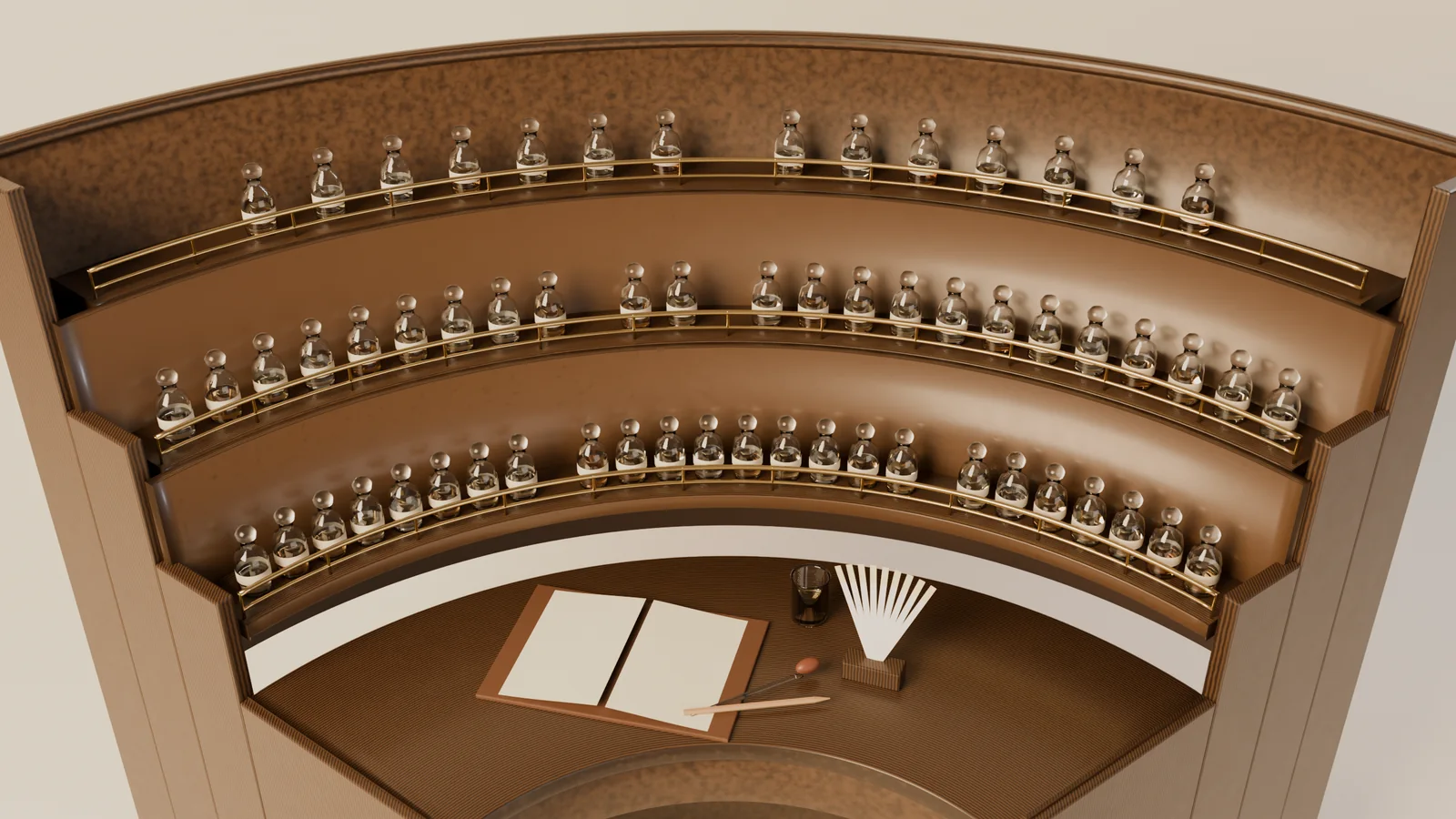
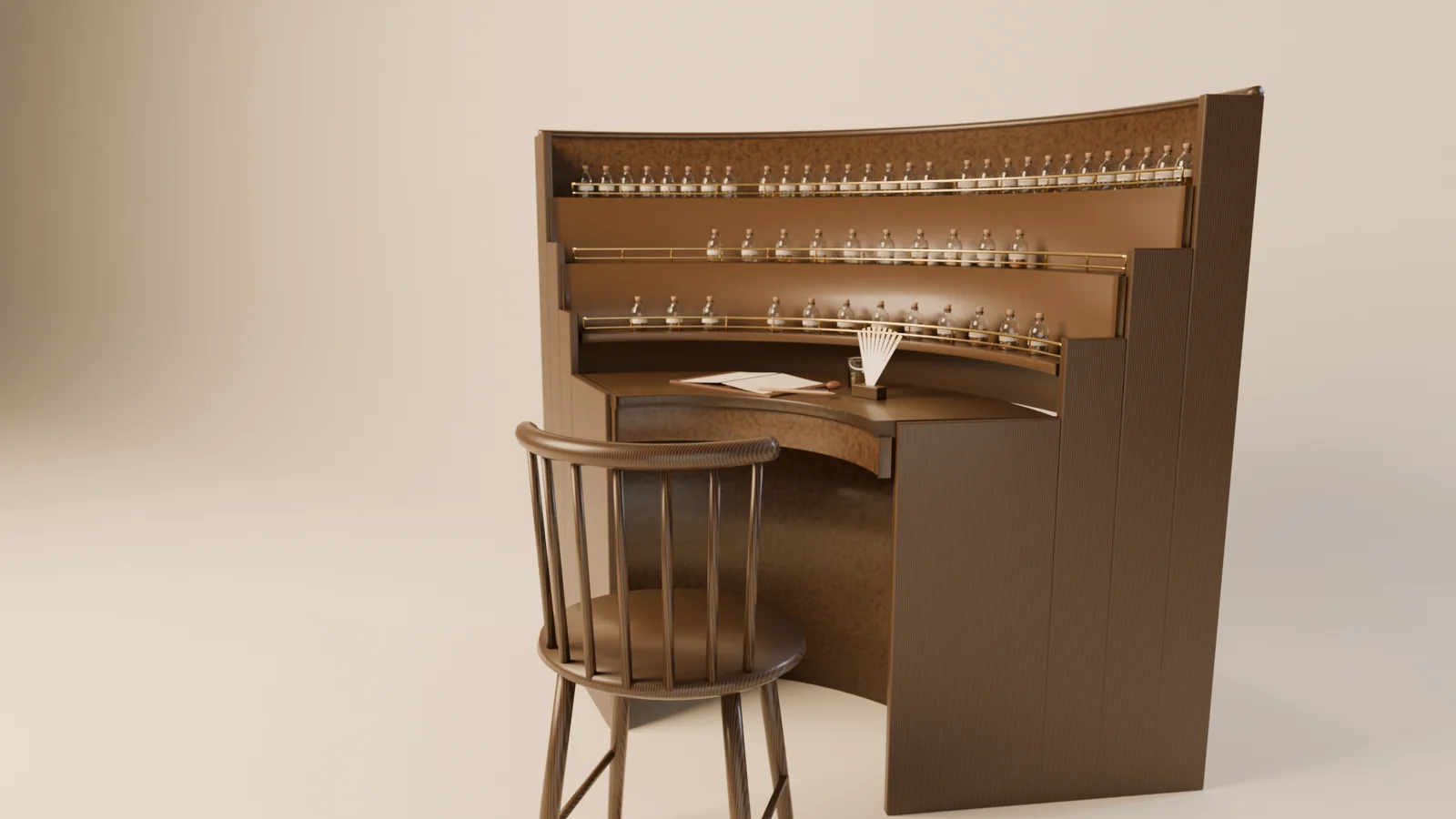
Every perfumery school begins with memorization. Students must learn to identify hundreds of raw materials blind — naturals and synthetics alike. This isn’t just naming: it’s understanding character, volatility, blending behavior, and appropriate dosage. A student might smell linalool again and again before truly “knowing” it. The organ — the perfumer’s workbench arranged like a pipe organ — becomes an extension of memory.
Smelling technique matters. Strips (mouillettes) are dipped into materials, waved gently to volatilize, brought to the nose at a 45° angle. Never sniff directly from a bottle — you’ll fatigue your receptors instantly. Professional perfumers develop rituals: smelling in the morning when the nose is freshest, stepping outside between evaluations, tracking how materials evolve over hours. Some smell their own skin as a “reset” baseline.
After materials come accords — learning to blend notes into unified impressions. The fougère accord (lavender + coumarin + oakmoss), the amber accord (vanillin + benzoin + labdanum), the leather accord (birch tar + isobutyl quinoline + castoreum alternatives). Students spend months on each, understanding how proportions shift the balance. A small change in proportion can transform the impression entirely.
Students analyze classic fragrances by smell, attempting to reverse-engineer formulas. No access to the original formula — just a bottle of Shalimar and the challenge to recreate it from memory. This teaches structure, proportion, and the thinking of master perfumers. Many training formulas are closely guarded; some teachers share only partial versions, forcing students to solve the gaps.
Real perfumery is almost always commercial. Students learn to work from briefs — "Create a fresh masculine for mass market, within a tight cost-per-kilo ceiling, must test well in focus groups." The creative challenge isn’t pure expression; it’s expression within constraints. Cost limits, IFRA regulations, marketing requirements, target demographics. The art is in making something beautiful within the box.
Perfumers develop eidetic olfactory memory — the ability to recall smells with precision years later. This isn’t natural talent alone; it’s deliberate practice. Daily smell-journals, blind identification tests, constant exposure. The goal is to “think” in smell: to compose in the mind before ever weighing materials. Some perfumers dream in scent. The transformation is neurological — the olfactory cortex physically changes.
The Major Schools
Where do perfumers train? A handful of institutions dominate the field, each with distinct philosophies.
1 labeled
Evidence for this section: 1 labeled
Perfumery Difficulty & Learning
Perfumery is a demanding creative discipline to master. The learning curve is brutal, the materials are expensive, and the feedback loop is measured in years. Here’s what the journey actually looks like.
Olfactory Vocabulary
You cannot create what you cannot smell. The early years are pure study — smelling reference materials, building mental associations, learning to distinguish linalool from linalyl acetate. Beginners can name only a handful of materials blind; professionals know hundreds.
Accord Construction
An accord is 2-5 materials that blend into something greater than their parts. Fougère = lavender + coumarin + oakmoss. You’ll spend years learning why some combinations work and others clash. Most of your experiments will fail. The balance of top, heart and base becomes intuitive.
Full Composition
A finished fragrance can hold dozens of materials. Balancing them requires understanding volatility curves, tenacity, sillage, and how materials behave over 8+ hours on skin. Your formulas will go through many iterations, and a single composition can take years to finalize.
Professional Mastery
At this level you’re working from a concept to a formula without trial-and-error. You can read a brief and know which materials you’ll need. You understand IFRA restrictions, cost optimization, stability testing. You can create for a target demographic. You’ve trained your nose for many thousands of hours.
A basic evaluation kit costs a few hundred to a few thousand dollars. A professional organ costs far more. Premium naturals (orris butter, rose absolute, oud) are very costly. Every failed experiment costs money.
Minimum startup: a modest budget for a starter set of materials, scales, pipettes, alcohol, and mouillettes.
Professional perfumers at major houses train full-time for years before creating their first released fragrance. Self-taught perfumers working part-time should expect many more years to reach comparable skill. There are no shortcuts — only repetition and refinement.
Daily practice: a few hours of smelling, blending and evaluation; the nose tires after a few hours.
ISIPCA (France)
A long-established school. 2-year masters program in Versailles. Requires chemistry background. Graduates are recruited directly by the major houses.
Grasse Institute of Perfumery
A professional program in the birthplace of French perfumery. Focus on both technical and creative aspects. Strong connections to Grasse-based natural material producers.
Self-Directed Study
Textbooks (Arctander, Carles), online courses (Perfumers World, IFF Masterclass), community forums (Basenotes, r/DIYfragrance). Slower but accessible. Requires self-discipline and willingness to fail repeatedly.
Perfumery is an art of a sense closely tied to emotion — and that is what makes it both powerful and difficult. You cannot intellectualize smell. You can only smell.
3 labeled
Evidence for this section: 3 labeled