The Science · Chapter 5 of 5
The Olfactory Laboratory
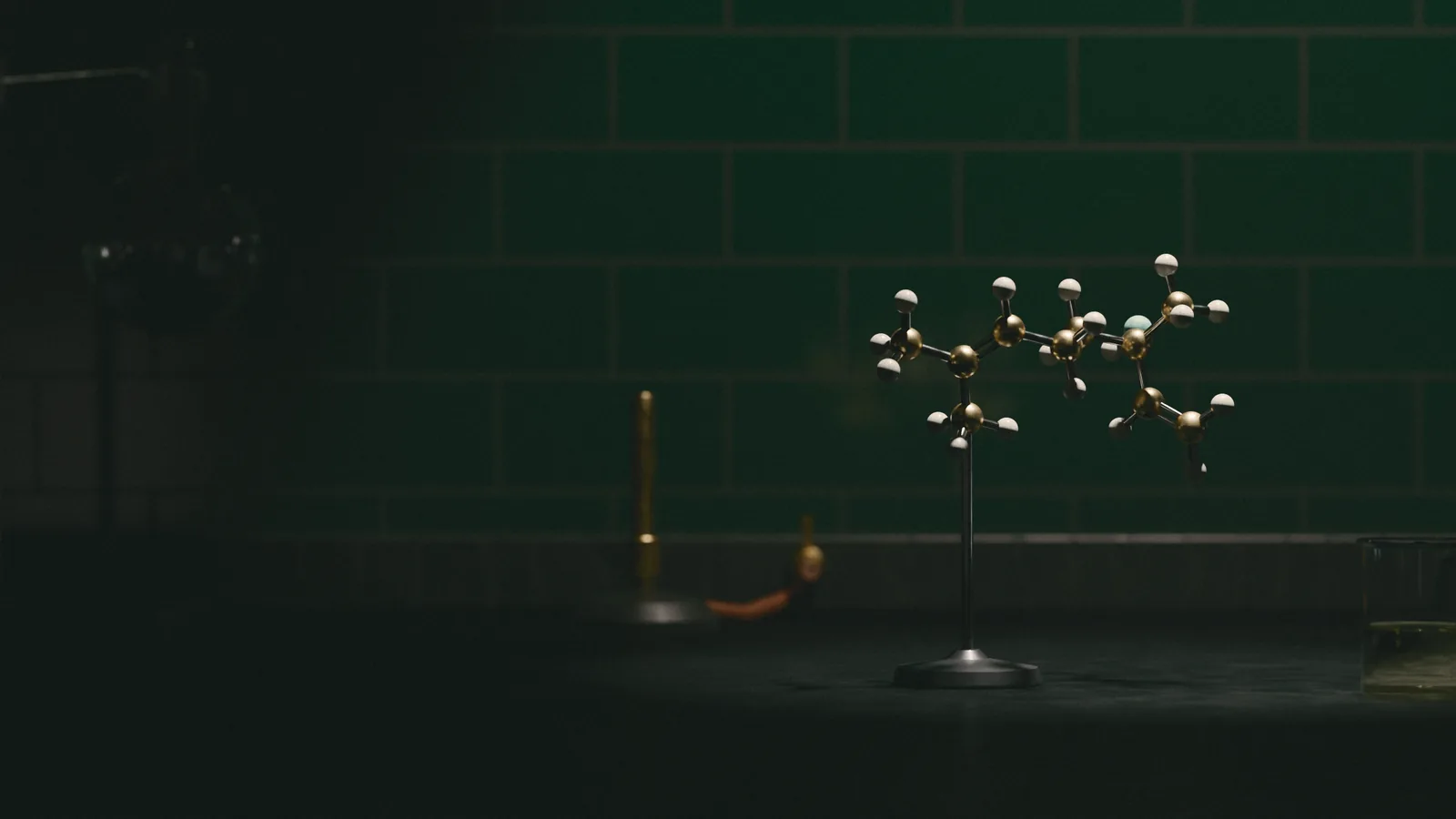
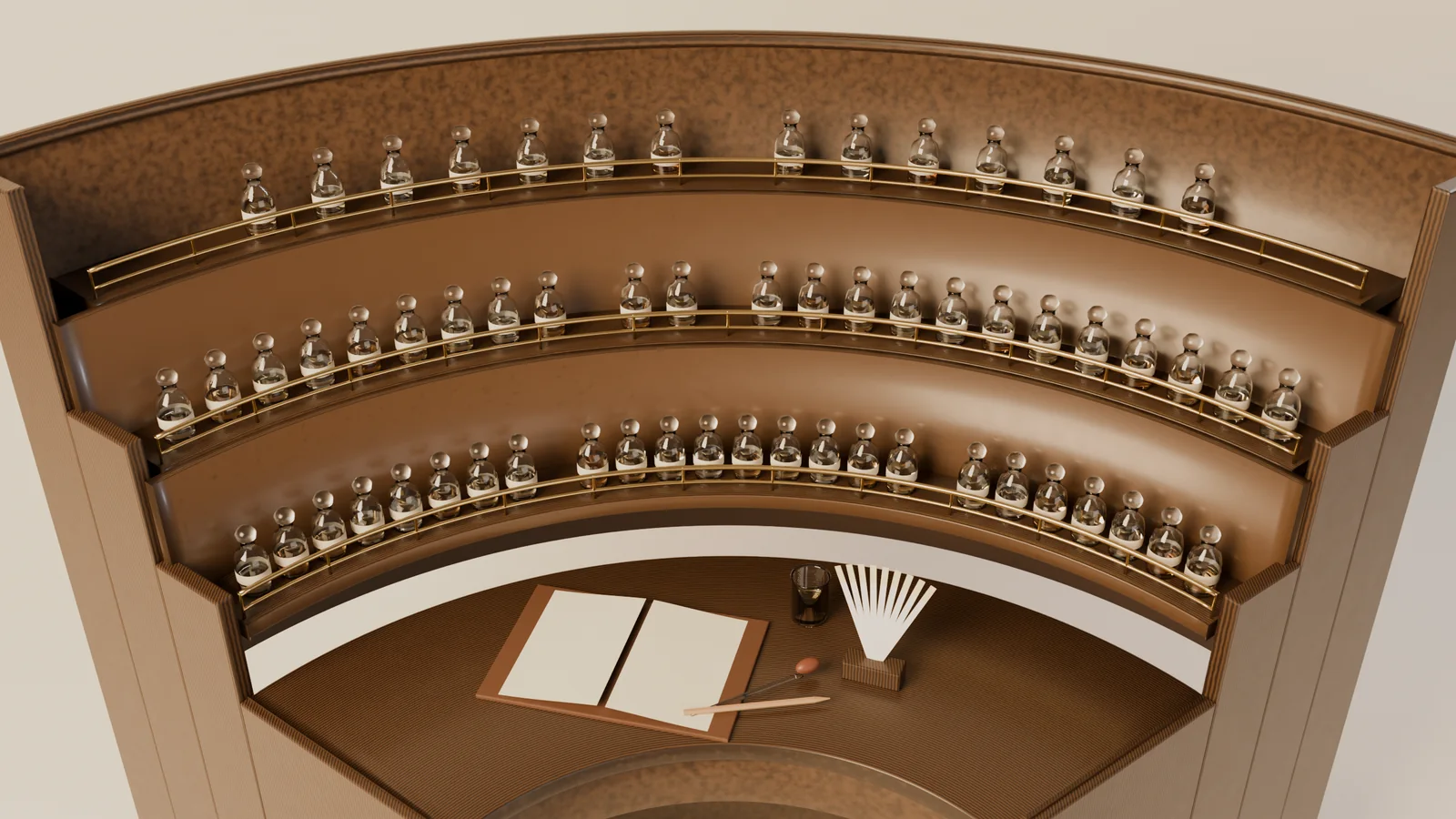
Accord architecture, and tools for exploring how fragrance behaves: diffusion, evaporation, dilution and projection. Each is a simplified model, and says so.
About 7 minutes of reading
The Lab
A master perfumer builds a fragrance accord by accord, not note by note — structural frameworks that have defined entire categories for over a century. Learn these three and you can read many modern formulas.
A dominant masculine structure for over a century. Named for “fern” — a scent ferns do not actually have. Its defining character is synthetic: coumarin, synthesized by Perkin in 1868, is its signature. A great many masculine fragrances descend from it.
Often described as an intellectual fragrance structure. Named for Cyprus (Chypre); François Coty made it a commercial accord with his Chypre. Restrictions on oakmoss under the IFRA Standards have since changed the modern chypre, and many feel the family lost something.
The warmest, richest structure in the perfumer’s palette. Built on a foundation of vanilla, resins, and animalic musks, with a spiced floral heart. Shalimar — in the house’s legend, an existing composition to which Jacques Guerlain added a large dose of vanillin — remains the archetype. The oriental represents desire in its most unambiguous olfactory form.
3 labeled · 1 unsourced
Evidence for this section: 3 labeled · 1 unsourced
The Olfactory Laboratory
Seven tools for exploring how fragrance behaves — diffusion, evaporation, color associations, classification, cost. Each is a simplified model, and says so.
A simplified particle picture of a spritz spreading through still or moving air (modeled, not a physics simulation). Lighter, more volatile molecules spread and fade first. Warmer air spreads them faster.
Lighter molecules diffuse faster: limonene (136 g/mol) before linalool and geraniol (154 g/mol), before patchoulol and ambroxan (222 and 236 g/mol). Molar masses from PubChem; the particle speeds on screen are modeled.
Build your olfactory profile across 8 axes of the fragrance wheel. The polygon morphs live as you adjust — watch your accord take shape visually. It compares your blend with a set of fragrance families and names the closest (the house’s own model).
How a fragrance changes on skin over twelve hours, drawn from the same evaporation model as the drop on skin above: each material fades by its half-life. The half-lives are the site’s own constants — relative evaporation, modeled.
The opening
Every material is still fully present; the lightest ones lead.
site constants, chosen for the simulator and not measurements: remaining = e−0.693 t / half-life; the three accords are illustrations built from the simulator’s eight materials, not formulas.
Many people link smells with colors, and studies find shared tendencies across groups — an evocation, not a rule (a lemon is not “science-says” yellow). This painter uses the house’s own mappings to render your blend as abstract color. Select notes and watch your formula become a painting.
Twelve questions of the house’s own design map your scent preferences to fragrance families, notes, and famous perfumes worth smelling. A starting point for your nose, not a test.
Calculate the economics of splitting bottles, determine cost-per-spray, and find the sweet spot between decant sizes and full bottles. Your own prices go in; the sprays per milliliter are modeled (8, 10, 12 and 15 by concentration), and the presets are example prices, not quotes.
Master the art of fragrance application. Where you spray, how much, and on what surfaces dramatically affects longevity, projection, and how your scent evolves throughout the day.
Warm areas where blood vessels are close to skin surface. Heat helps fragrance molecules evaporate and project.
- Wrists — Classic; rubbing them together is said to dull the opening
- Neck sides — Excellent projection, catches air movement
- Behind ears — Subtle, intimate sillage
- Inner elbows — Warm, moves with gestures
- Behind knees — Heat rises, scent wafts upward
- Chest/décolletage — Personal scent bubble
Both hold scent longer than skin due to their porous nature, but require care.
- Hair mist — Spray brush, then brush through (alcohol dries hair)
- Clothing — Spray 8-10 inches away, test for staining first
- Scarves — Excellent scent carriers, especially silk and wool
- Jacket lapels — Movement creates sillage trail
- Cloud method — Spray into air, walk through mist for even distribution
- Moisturize first — Fragrance lasts longer on hydrated skin
- Layer intelligently — Unscented lotion base extends longevity
- Distance matters — 6-8 inches for spray, prevents alcohol burn
- Let it dry — Wait 30 seconds before dressing over spray
- Don’t rub — Let it dry on its own; friction warms and hurries the top notes
Good storage keeps a fragrance close to how it left the bottle for much longer. Understand the enemies of perfume and how to protect your collection.
- Keep in original box — Best UV protection
- Store upright — Prevents seal degradation
- Dark drawer or closet — Away from humidity
- Cool, stable temperature — Avoid fluctuations
- Don’t decant unnecessarily — Each transfer introduces air
- Wine fridge works — Ideal conditions for precious bottles
- Trust your nose — Off smells indicate degradation
Find the perfect fragrance for any occasion. Select your context and get curated recommendations matched to weather, formality, and setting.
Explore the masters of perfumery. Browse noses, their signature styles and their creations. Understanding a perfumer’s DNA helps predict whether you’ll love their other works.
Considering a blind buy? Calculate your risk level based on fragrance characteristics, your preferences, and market factors. The score is the house’s own model, a nudge rather than a verdict.
Not all fragrances belong in the workplace. Browse the house’s office-friendliness opinions, based on projection, polarizing notes, and overall appropriateness for professional settings.
- Apply 1-2 sprays maximum — less is always more at work
- Choose EDT over EDP for lighter projection
- Reapply is rarely needed — you go nose-blind, others don’t
- Ask a trusted colleague if you’re unsure
- Consider fragrance-free for sensitive environments
Finding the perfect fragrance gift is an art. Answer a few questions about the recipient and get curated recommendations tailored to their personality and preferences.
The house’s picks from other houses; ranges are rough and prices change; nothing here is for sale
Fragrance is personal: a small sample or a travel size lets them try it on skin before a full bottle.
7 sourced · 8 labeled · 1 unsourced
Evidence for this section: 7 sourced · 8 labeled · 1 unsourced
Sources cited here include: Osmothèque, Conservatoire international des parfums
Volatility Curve Simulator
Watch how different molecules leave the skin over time: a drop of each, side by side, and the curve it follows. Why do some notes fade in minutes while others stay for hours?
| Molecule | Note | Half-life | Remaining |
|---|---|---|---|
| Limonene | top | 1.5 h | 100 % |
| Hedione | heart | 6 h | 100 % |
| Ambroxan | base | 12 h | 100 % |
1 labeled
Evidence for this section: 1 labeled
Dilution Calculator
Calculate exact measurements for diluting essential oils and aroma chemicals to a target concentration. The pipette pours what the numbers say.
- Aromatic material
- 1.00 ml
- Drops
- ~20 drops, modeled (20 per ml)
- Carrier
- 9.00 ml Perfumer’s Alcohol
- Makes
- 10.00 ml at 10%
1.00 ml of aromatic material plus 9.00 ml of Perfumer’s Alcohol makes 10.00 ml at 10%. About 20 drops (modeled, at 20 per ml).
1 labeled
Evidence for this section: 1 labeled
Projection Estimator
A rough estimate of how far a fragrance projects with its concentration, the temperature and where you apply it. Every constant in it is modeled, not measured.
Application area
the zones, bar widths and durations are the house’s simplified model; real projection varies with the formula, the skin and the air.
6 labeled · 1 unsourced
Evidence for this section: 6 labeled · 1 unsourced