The Science · Chapter 3 of 5
From the Still to the Accord
Extraction methods from ancient steam distillation to headspace capture, the olfactory pyramid, and how an accord is built.
About 8 minutes of reading
Extraction Methods
Capturing scent from raw materials requires techniques refined over millennia — from ancient steam distillation to modern headspace capture of living flowers.
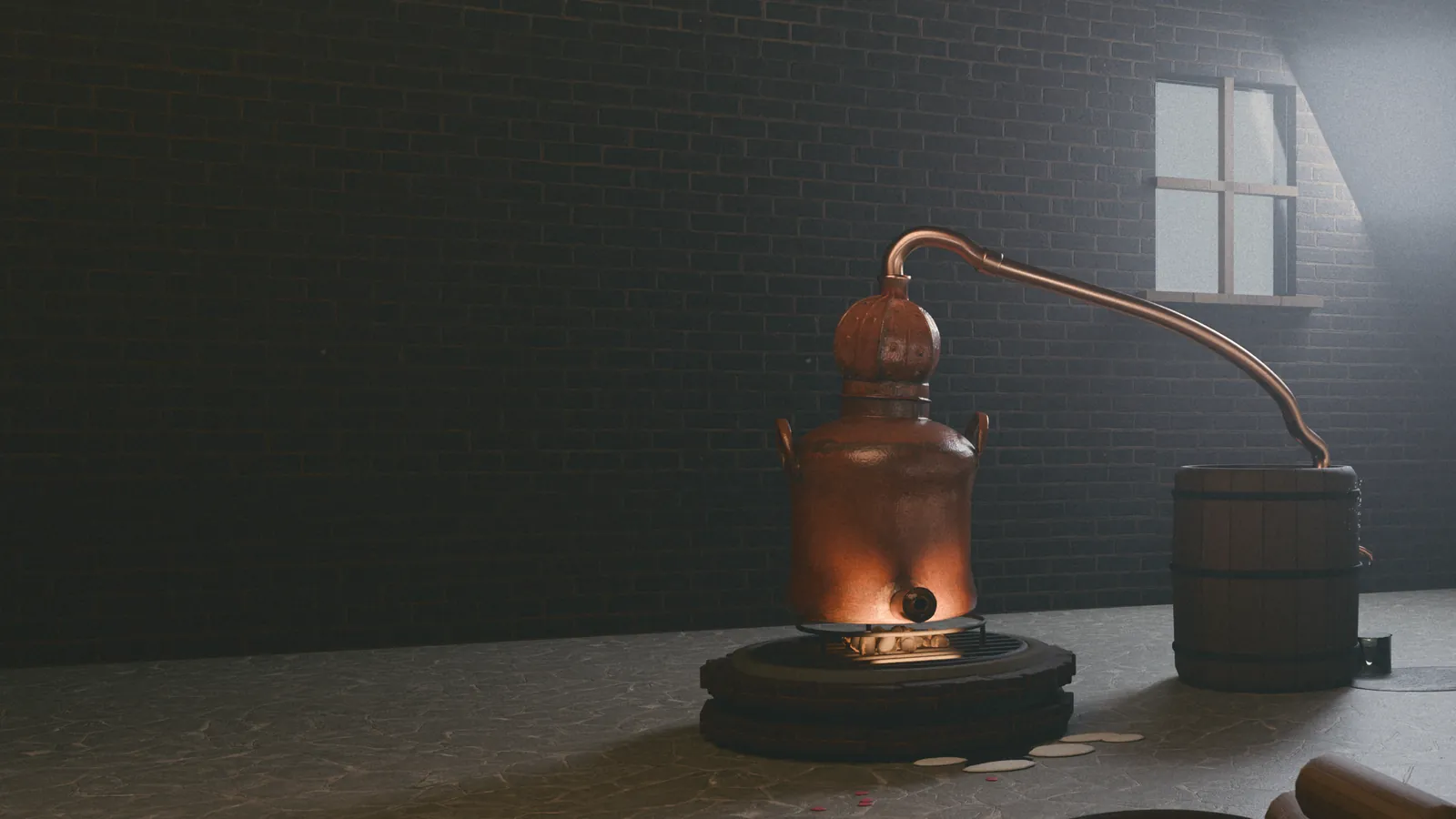
See the copper still rendered in-house, at full size (Plate SC-1, 2560 × 1440 pixels)
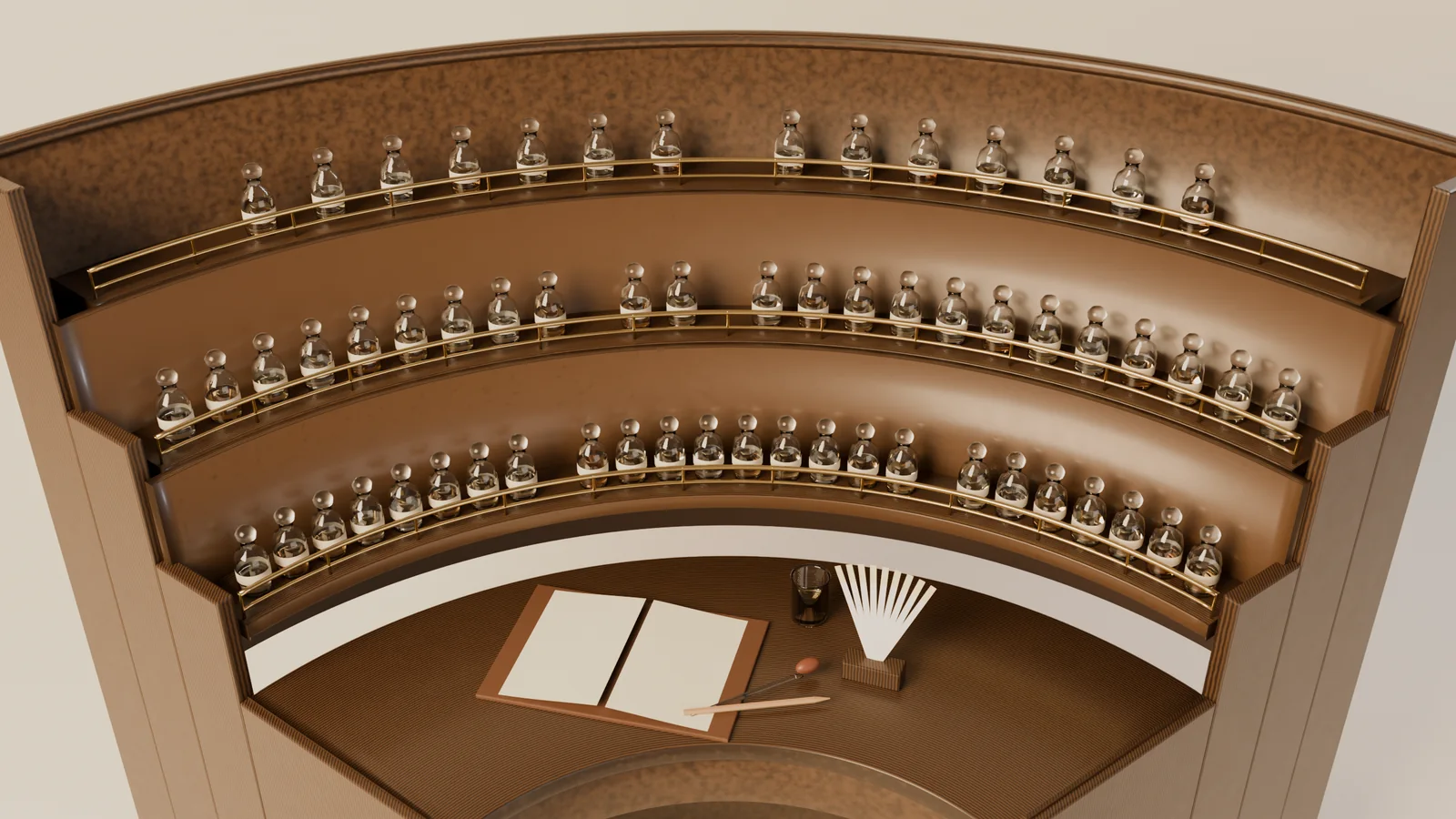
View in your room: the proof flacon (needs JavaScript).
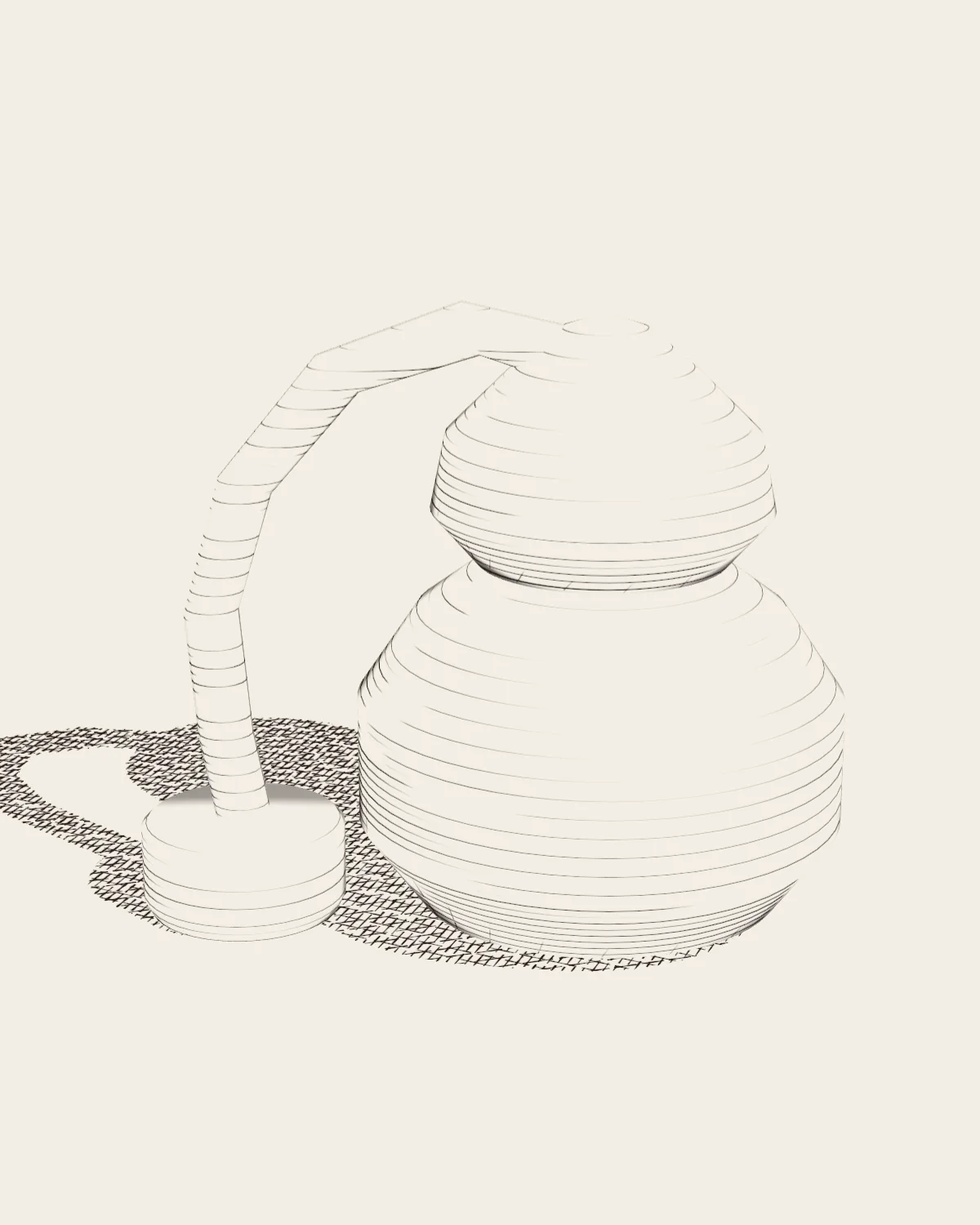
View in your room: the alembic (needs JavaScript).
View in your room: the enfleurage chassis (needs JavaScript). All the models.
Transcript
The film has no sound and no words. What it shows, in order:
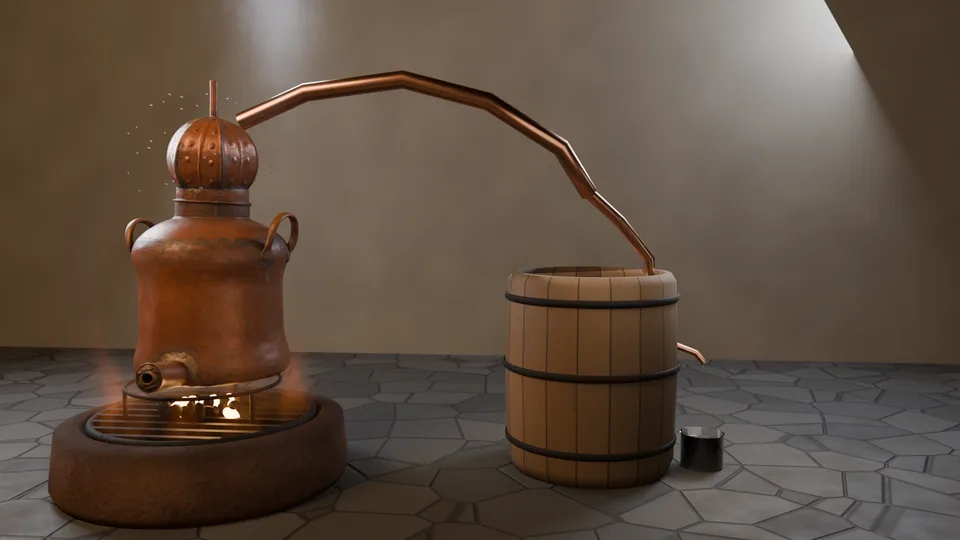
- A copper still over a hearth fire, in a room with a stone floor.
- Steam curls from the still’s head.
- Its swan neck runs to a wooden cooling tub and a small receiver beside it.
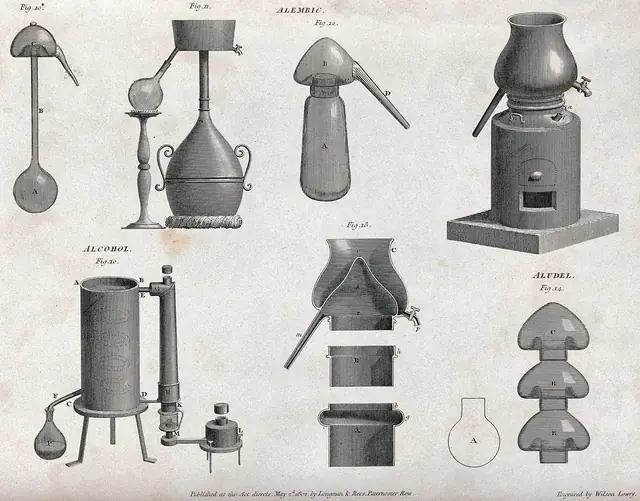
A widely used extraction method. Steam passes through plant material, vaporizing volatile aromatic compounds which condense back into liquid. The essential oil floats atop the hydrosol. True to the plant but may lose heat-sensitive compounds — delicate esters can be destroyed before they can be captured.
Transcript
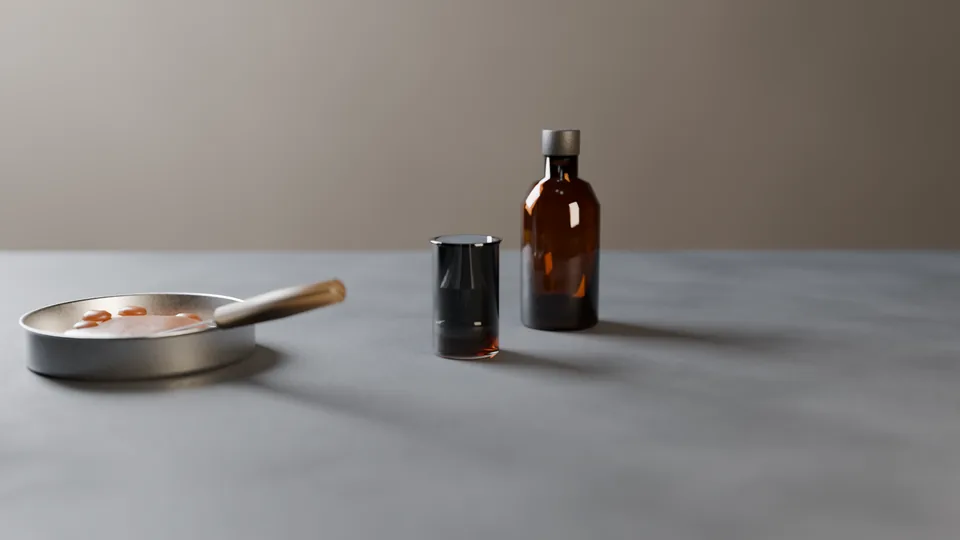
The film has no sound and no words. What it shows, in order:
- Jasmine flowers turning in clear hexane in a tall glass extractor.
- The view moves along the bench to the waxy concrete in a steel tin.
- It ends on the dark absolute in a small bottle beside a dark jar.
Delicate flowers are washed with solvents (typically hexane) to create a waxy “concrete.” Alcohol then separates aromatic compounds into an “absolute” — more complete and true-to-nature than distilled oils. Steam distillation loses much of jasmine’s character; solvent extraction captures what distillation misses.
Transcript
The film has no sound and no words. What it shows, in order:
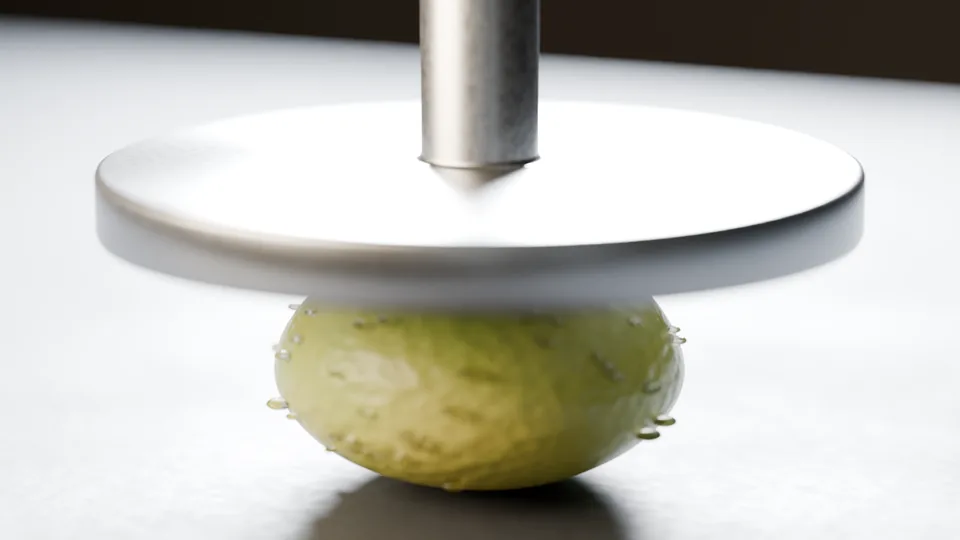
- A bergamot on a pale bench.
- A round steel plate comes down and presses it.
- Oil beads on the peel and sprays off in fine droplets.
Citrus oils are obtained by mechanically pressing rinds, rupturing oil glands without heat. This cold-press method preserves the bright, zesty character that distillation would destroy. Bergapten — a furanocoumarin in bergamot that reacts with sunlight on skin — can be removed to make the “FCF” (furanocoumarin-free) grade perfumers commonly use.

Transcript
The film has no sound and no words. What it shows, in order:
- Jasmine flowers laid in white fat in a wooden frame (a chassis).
- A second chassis is lowered onto them and pressed down.
- It lifts away again, with a few flowers stuck to it.
A traditional method where flowers are pressed into odorless fats, which absorb fragrance over days. The scented fat (pomade) is washed with alcohol. Rarely used today due to labor intensity, but still practiced by artisan houses in Grasse. Produces especially “alive” representations of delicate flowers — closest to the living bloom.
Transcript
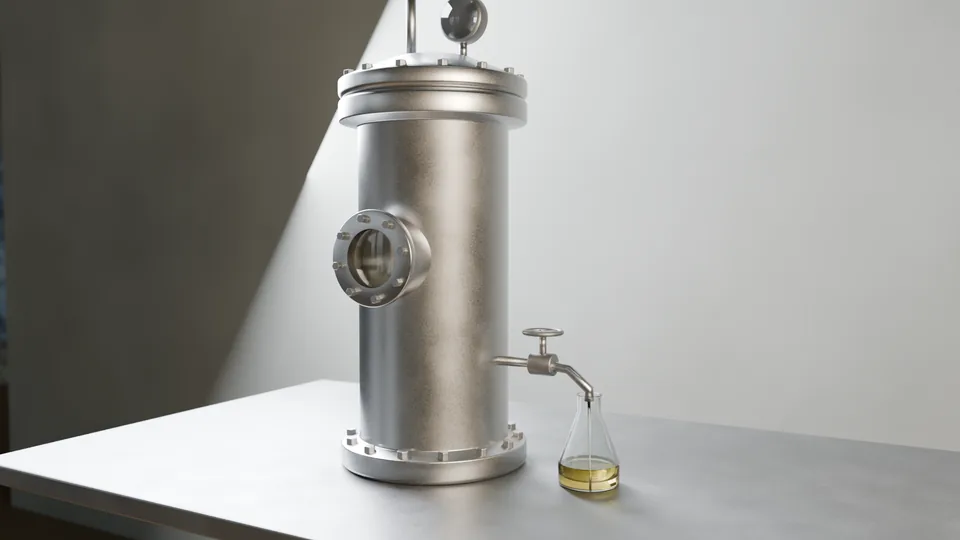
The film has no sound and no words. What it shows, in order:
- A stainless pressure vessel with a round sight-glass, on a bench.
- Carbon dioxide swirls behind the glass (illustrative).
- A pale-gold extract trickles from the tap into a glass flask.
Supercritical carbon dioxide acts as solvent at high pressure, producing pure, true-to-nature extracts with little or no solvent left behind. Increasingly used for fine ingredients. The CO₂ extract of ginger, black pepper, or frankincense bears little resemblance to the steam-distilled version — it is far more alive.
Captures scent molecules in the air around a living flower without harming it. Allows recreation of scents impossible to extract by traditional means. Lily of the valley gives no usable oil, so muguet (lily of the valley) fragrances are compositions built from analyses of the living flower.
1 sourced · 3 labeled
Evidence for this section: 1 sourced · 3 labeled
Sources cited here include: International Fragrance Association (IFRA)
The Olfactory Pyramid
Every fragrance unfolds over time. A master perfumer composes this temporal architecture deliberately — the opening statement, the true argument, the memory left behind.
The pyramid is driven largely by vapor pressure. Small, lightweight molecules like limonene (C₁₀H₁₆, the lemon molecule) have high vapor pressure — they evaporate fastest and fade first. Large, complex compounds like muscone (C₁₆H₃₀O, 15-membered ring) have vanishingly low vapor pressure — they can linger on skin long after the rest has gone.
A fragrance’s sillage is something else: the scent wake it leaves behind as its wearer moves through the world. Composing this temporal architecture deliberately, in full knowledge of the molecular physics, is one of perfumery’s great technical achievements.
2 sourced · 4 labeled
Evidence for this section: 2 sourced · 4 labeled
Sources cited here include: PubChem Compound Summary for CID 22311, 1-Methyl-4-Prop-1-En-2-Ylcyclohexene; PubChem Compound Summary for CID 7160826, Muscone. National Center for Biotechnology Information
Building an Accord
An accord is a blend of two or more materials that creates a unified olfactory impression neither material possesses alone. A rose accord can contain no rose absolute at all — a construction of citronellol, geraniol, phenylethyl alcohol and damascones that the nose reads as rose.
The Modifier
Many perfumers think in three roles: the body (the dominant note, most of the accord), the modifier (a smaller part that shapes and colors it), and the enhancer (a trace that makes everything smell more itself). The enhancer is often unexpected — a touch of vanillin that lifts an accord without smelling of vanilla.
Odor Strength (OU)
Materials vary by orders of magnitude in detection threshold. β-Damascenone is detected at 0.006 µg/kg in water, far below linalool’s 0.58 µg/kg in water in the same database, so a trace of it can dominate a formula made mostly of linalool. Always work in dilution: perfumers keep diluted stock solutions of their high-impact materials.
The Transparent Fixative
Ambroxan, Iso E Super, Habanolide — these are not smelled so much as felt. They amplify everything around them. A few percent of ambroxan can make the other ingredients seem to project further and last longer without adding a distinct note of its own. They are the invisible architecture of modern perfumery.
The Causal Debugger, on each teaching accord: change one component and follow the chain, with its evidence — rose · chypre · fougère · amber · cologne · muguet · white floral · woody-ambery
3 labeled
Evidence for this section: 3 labeled
More Accords
Beyond the classical trinity of fougère, chypre, and oriental lie other crucial accord structures that define entire fragrance categories.
The amber accord recreates the warm, sweet, balsamic character of ambergris without using actual whale-derived material. It sits at the heart of many oriental fragrances, giving warmth, depth and a skin-like sweetness.
The headiest, most intoxicating floral structure. Built from jasmine, tuberose, and gardenia — all white flowers containing indole at trace levels. The combination is deliberately excessive, narcotic, sometimes scandalous. Patou’s Joy and Piguet’s Fracas are its classics. Where the soliflore aims for realism, the white floral accord aims for overwhelming beauty.
A category impossible before synthetic chemistry. Calone (benzodioxepinone) smells like sea spray, watermelon rind, ozone — none of which exist as extractable natural materials. Combined with transparent florals and light musks, it evokes the beach, the rain, fresh air. It shaped the “fresh” aesthetic of the 1990s, L’Eau d’Issey among its examples.
Recreates the smell of tanned leather — specifically, the Russian leather once prized for its birch-tar treatment. The accord evokes saddles, gloves, old books, power. Historically built with rectified birch tar (now held to a purity specification by an IFRA Standard, the industry’s own rules, not law in the US), castoreum (now replaced by synthetics) and smoky phenolics. Modern versions rely on Isobutyl quinoline and suede synthetics. A masculine classic now increasingly worn by women.
The “edible” accord — deliberately food-like sweetness in fine perfumery. Before Mugler’s Angel it was widely thought vulgar. Ethyl maltol (cotton candy), vanillin (cream), praline (nuts), coffee, chocolate — layered over an unexpected base of patchouli. The clash of sweet and dark shaped a generation of caramel, coffee and vanilla fragrances.
Fresh-cut grass, crushed leaves, spring gardens — the “green” family captures photosynthesis itself. Germaine Cellier’s Vent Vert for Balmain made it famous with generous galbanum and violet leaf. The category evokes nature more literally than florals do — not the flower but the foliage. Requires bitter, sharp, almost abrasive materials that need careful handling.
7 labeled
Evidence for this section: 7 labeled