Inflation first
A list price that rises no faster than inflation has not really risen. Before comparing two years, put both prices in the same year’s money.
The Library · Chapter 4 of 4
Where the shelf price goes, how clones are made, the brief economy, IFRA restrictions, perfumer ownership and the independent houses.
About 20 minutes of reading
The techniques perfumers use that rarely appear in marketing — tricks of the trade passed down through apprenticeships and guarded within the major houses.
Some commercial concentrates carry a share of diluent (often dipropylene glycol or isopropyl myristate) even before alcohol dilution. The actual aromatic concentrate — what perfumers call the “juice” — can be a smaller share of what’s in the compounding tank. When a formula is priced per kilo, that’s the concentrate; the finished product costs far less per unit volume. Niche brands may use higher concentrate percentages, but the economics limit how far they go.
The spray you smell immediately after application is not fully representative of the fragrance. Some perfumers deliberately “pad” the headspace — the opening moments of evaporation — with cheap, attention-grabbing notes that fade within minutes. The goal is to impress during the brief moment someone tests in-store. The fuller fragrance emerges later, often after the customer has already decided.
Many “natural” fragrances rely on synthetics for lift and longevity. Iso E Super is in a great many formulas — its velvety cedarwood-musk acts as a “fragrance amplifier” that makes other notes project further. Ambroxan serves similarly. A fragrance marketed as “100% natural” may, under some definitions, still use nature-identical molecules produced synthetically. The distinction is one of labeling, not smell.
Perfumers rarely build fragrances note by note from scratch. They work from pre-built accord skeletons — base formulas representing “rose accord,” “amber accord,” “leather accord.” These may contain dozens of ingredients each, balanced over years of refinement. A “new” fragrance often means combining existing accords in novel ratios, adding a distinctive top note, and adjusting for the brief. True ground-up composition is less common and costly.
Briefs specify cost ceilings per kilo of concentrate — low for mass-market, higher for prestige, higher still for niche. Perfumers become masters of illusion, creating the impression of expensive materials using cheap substitutes. “Oud” in an inexpensive fragrance is often cypriol and synthetic bases; genuine oud would strain the budget on a single note. Rose oxide and other synthetics stand in for rose absolute at a fraction of the cost.
Modern perfumers often use several different musks in a single formula, each covering different facets of the musk spectrum and compensating for partial anosmia in the population. Galaxolide (white musk), Habanolide (warm), Ethylene Brassylate (powdery), Muscone (animalic) — stacked together, they help ensure most people smell something, even if specific receptors are missing. This is common practice, not exceptional.
Many modern fragrances are deliberately linear — smelling the same from first spray to dry-down. This isn’t laziness; it’s strategic. Fragrances that evolve dramatically are said to test poorly in focus groups, where consumers expect the bottle to smell like what they tried. A fragrance that transforms can confuse the mass market. Linearity is a feature for commercial success, not a flaw.
Marketing lists notes that may not exist in the formula at all. “Saffron” is often Safraleine or Safranal at trace levels. “Oud” is often synthetic bases. “Ambergris” is usually Ambroxan or similar. Worse: some listed notes are pure invention — “lunar essence” or “desert wind” — creating olfactory placebo effects. The note pyramid is largely marketing, not a formula disclosure. Perfumers and marketers operate in different realities.
Evidence for this section: 19 labeled · 2 unsourced
Where does the shelf price actually go? A rough sketch, not audited figures. The financial architecture of fragrance reveals uncomfortable truths about value, marketing, and the illusion of luxury.
The liquid inside a designer bottle is commonly reported to be a small part of its cost. You’re paying for the dream.
Niche often spends more on juice, less on advertising — but margins can remain generous.
A typical 100ml designer fragrance contains approximately 85ml of alcohol, 10-15ml of fragrance concentrate, and trace water. That concentrate is commonly reported to cost the brand very little. A celebrity campaign can cost many millions. Prime retail placement is said to carry its own large fees. You’re buying an olfactory experience wrapped in a marketing hallucination. This isn’t cynicism — it’s the business model. The question isn’t whether you’re overpaying for liquid; it’s whether the dream is worth the premium. For many, it genuinely is.
Most of what you pay for is not what is in the bottle.
Evidence for this section: 7 labeled
The house keeps no price history yet. The figures that stood here had no checked source, so they are gone; what remains is how to read a bottle’s price over time for yourself. Nothing here is for sale.
No prices are shown here: the house gives none it cannot source
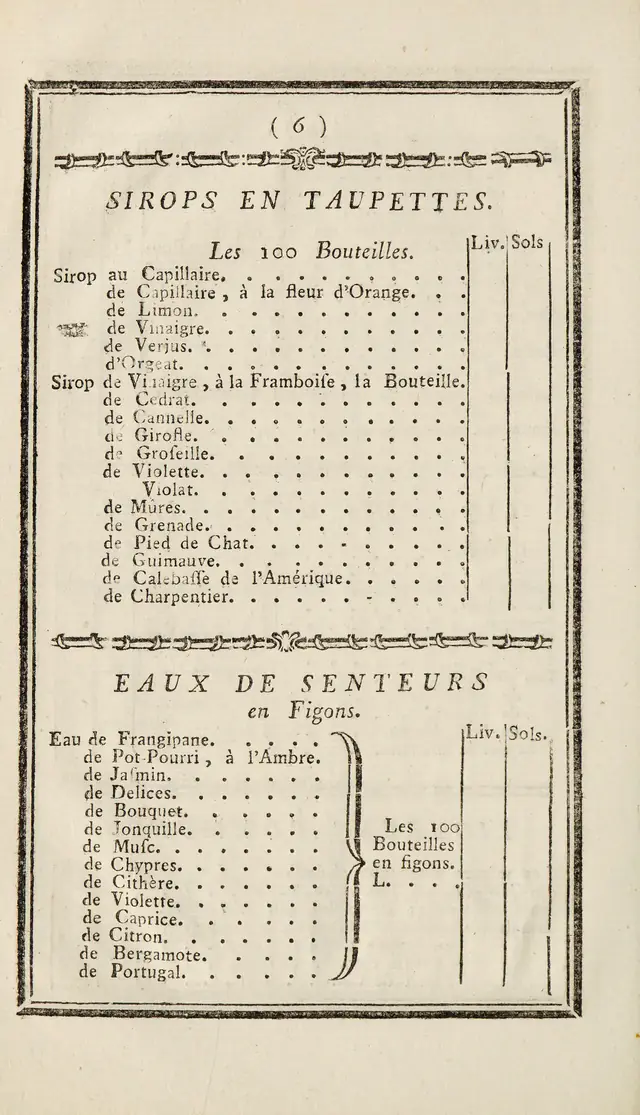
A list price that rises no faster than inflation has not really risen. Before comparing two years, put both prices in the same year’s money.
Materials are restricted by the IFRA Standards, become scarce or cost more, and houses rework their formulas. The name and the bottle can stay while what is inside changes, so a price is only comparable within one formulation.
A new bottle size or a new concentration (eau de parfum, parfum, elixir) resets a line’s prices. Compare like with like, and per milliliter.
Prices follow a house’s position more than what goes into the bottle: niche houses often raise the price of a fragrance as it becomes famous; designer lines move with the brand’s range.
Once a fragrance or a formula is discontinued, the house no longer sets its price: collectors do, bottle by bottle, and the asking prices vary widely.
Use dated sources: the house’s own price list, dated retailer listings and archived copies of both. Note the size, the concentration and the country, since prices differ between markets.
Evidence for this section: 2 labeled
How do clone houses recreate designer fragrances? The science of fragrance duplication — and why some clones work while others fail spectacularly.
Gas Chromatography-Mass Spectrometry is the clone maker’s primary tool. A fragrance sample is vaporized and passed through a column that separates components by volatility and polarity. Each peak represents a compound; the mass spectrometer identifies it. A skilled analyst can reconstruct much of a formula from GC-MS data alone. The catch: proportions are estimated, not measured. Small differences in amount are hard to read from the peaks. Getting ratios right requires extensive testing.
GC-MS identifies what’s in a fragrance — but captive molecules may not be available for purchase. Javanol, Hedione HC, Clearwood — these appear on the chromatograph, but they can be hard to buy outside Givaudan or Firmenich. Clone makers must substitute with available alternatives. Ebanol for Javanol. Standard Hedione for Hedione HC. These swaps are close but not identical. It’s partly why clones often smell “almost right” but miss something ineffable.
Natural ingredients vary batch to batch. The rose absolute in Chanel is reported to come from specific Grasse suppliers with multi-decade relationships. A clone maker sources from available brokers; the rose smells different. Vintage formulas compound this — they used materials that may no longer exist, or exist only in forms restricted by the IFRA Standards (the industry’s own rules) or by EU law. A house that follows IFRA could not use the oakmoss of older Mitsouko at the same level today.
Some fragrances resist duplication. Chanel No. 5 has been cloned countless times; few, if any, capture the original. Why? Likely proprietary aldehyde blends, specific jasmine and rose sources, decades of formula tweaking, and the ineffable balance Beaux achieved. The simpler the formula, the easier the clone. Acqua di Giò clones can be excellent. Mitsouko clones are widely found disappointing. Complexity resists reverse engineering.
Evidence for this section: 8 labeled · 4 unsourced
These alternatives appear to share key aroma materials with better-known originals.
Evidence for this section: 3 labeled
How consumer testing shapes — and distorts — the fragrances that reach market. The hidden influence of untrained noses on professional perfumery.
Focus groups often evaluate fragrances in brief exposures — long enough to smell the headspace, nowhere near long enough to evaluate dry-down. This tends to favor top-heavy compositions with aggressive, attention-grabbing openings. Subtle fragrances that reveal themselves over hours often struggle in focus groups. The method tends to select for loudness, not quality. Many perfumers know this and design accordingly.
Focus groups measure average approval across the sample. A fragrance that half love and half hate scores poorly — it’s “polarizing.” A fragrance everyone finds “pleasant” but nobody loves scores well. This methodology tends to weed out bold compositions in favor of inoffensive mediocrity. Angel reportedly tested poorly; it succeeded partly because Thierry Mugler backed it anyway.
Consumers often lack vocabulary to articulate olfactory experience. “Too strong,” “too sweet,” “smells old” — these vague descriptors can drive reformulations that strip character. When a focus group says “smells old,” they may mean oakmoss (heritage material) or simply unfamiliarity. Perfumers must interpret untrained responses, sometimes incorrectly. The gap between what consumers say and what they mean can be wide.
Focus groups tend to be run in a handful of key markets. Fragrances that perform in those markets advance; those with only regional appeal are often dropped. A fragrance one market adores but another finds “strange” may never launch globally. The focus group process tends to push global fragrance toward common-denominator preferences.
Why does niche perfumery exist? Partly because niche houses can bypass focus groups entirely. Houses such as Frédéric Malle, Serge Lutens and Comme des Garçons are often cited as releasing what their perfumers create, with little consumer testing. The result is riskier — some creations fail commercially — but also more distinctive. When you buy niche, you’re buying freedom from the focus group regime. That freedom has value beyond the liquid in the bottle.
Evidence for this section: 10 labeled · 2 unsourced
Leaked formulas, authorship quarrels and regulatory fights. Darker chapters of the perfume industry that PR departments rarely discuss.
Evidence for this section: 4 sourced · 13 labeled · 11 unsourced
Sources cited here include: Osmothèque, Conservatoire international des parfums; Regulation (EC) No 1223/2009 of the European Parliament and of the Council of 30 November 2009 on cosmetic products…; International Fragrance Association (IFRA)
The International Fragrance Association sets limits on ingredients. Some are sensible safety measures. Others are more debated. Here is what IFRA’s Standards (industry rules, not law in the US) and EU law now limit.
These early synthetic musks were the backbone of classic perfumery. They are prohibited in cosmetic products in the EU (EU law: listed in Annex II of Regulation (EC) No 1223/2009, on safety grounds; the Annex entries are not listed on this site). US law: not on record here. They are often credited with the powdery warmth of classics of that era. Modern versions use polycyclic musks instead — which smell noticeably different.
The defining note of the chypre family. Restricted by an IFRA Standard (an industry code, not law): atranol and chloroatranol each below 100 ppm in the extract; and both prohibited in EU cosmetics (EU law). Original oakmoss gave Mitsouko, Miss Dior, and Femme their green-mossy depth. Modern “oakmoss” is often built on synthetic Evernyl, which many find less complex. The old chypre, as it was, is hard to find.
An early synthetic aroma material (Perkin, 1868), coumarin smells of new-mown hay, vanilla, and tonka bean. Defines the fougère family. Limits are one reason modern fougères often read brighter and less warm than classics. Original Fougère Royale would likely not meet today’s limits.
Natural jasmine contains IFRA-restricted components. This limits the lush, indolic jasmine that defined golden-age florals. Modern jasmine fragrances use blends with synthetic hedione and indole to approximate the effect — but the richness is reduced.
The key component of lemon, lime, and lemongrass oils. Essential for fresh, sparkling openings. Limits are workable for most applications but restrict truly citrus-dominant compositions from achieving full impact.
The spicy-sweet compound in clove, carnation, and rose. Carnation and clove-heavy compositions must stay under limits. Historic spicy orientals were built on unrestricted eugenol — modern versions are toned down.
IFRA Standards are the industry’s own rules, not law in the US. In the EU, a cosmetic product must undergo a safety assessment before it is placed on the market, under Regulation (EC) No 1223/2009.
Evidence for this section: 3 sourced · 10 labeled · 1 unsourced
Sources cited here include: International Fragrance Association (IFRA); Regulation (EC) No 1223/2009 of the European Parliament and of the Council of 30 November 2009 on cosmetic products…
Many celebrity fragrances are, by most accounts, marketing exercises with little creative involvement. But a few transcend the formula. Here is the house’s reading of which deserve a sniff.
One of the few celebrity fragrances created by a serious perfumer (credited to established perfumers). SJP reportedly had genuine creative input. Soft lavender, white amber, cedar — a quiet, sophisticated woody-musky scent that might be praised more widely without the “celebrity” stigma.
Competent fruity florals widely seen as good for the price. Well constructed. The series (Reb’l Fleur, Nude) was often praised for consistency — unusual for celebrity lines.
An early celebrity fragrance that showed the model could sell. Created, arguably, when celebrity scents were held to higher standards. A classic floral aldehyde that smells like actual perfumery. A widely worn celebrity fragrance.
A sweet white floral that sold in very large numbers. Credited to professional perfumers. Standard fruity-floral template but executed competently. Much of the appeal was the bottle — the scent sits close to many competitors.
The pattern, as widely described: pay the celebrity a large fee. Offer a handful of submissions. Minimal creative input. Launch with heavy marketing. Sell hard in year one. Discontinue when sales drop. Repeat with the next celebrity.
Evidence for this section: 9 labeled · 4 unsourced
Some fragrances are said to rise in value. Vintage bottles, discontinued gems and limited editions sometimes fetch more later — though nothing is certain.
Original ESP is reported to fetch well above its old retail price on the secondary market. Later production is said to differ. The original composition is no longer made.
Early Aventus batches, said to have stronger pineapple and smoky notes, are reported to command a premium. Batch variation means collectors seek specific production runs.
Older versions of oakmoss-heavy fragrances (Mitsouko, Miss Dior original, Femme) contain materials now restricted: oakmoss extracts by the IFRA Standards (the industry’s own rules, not law in the US), and atranol and chloroatranol, two natural components of oakmoss, prohibited in cosmetic products sold in the EU since 2019. Houses that follow those rules cannot make them the same way today.
Limited editions and discontinued Private Blends (Amber Absolute, Italian Cypress) are often reported to rise in value. Brand recognition supports demand.
Evidence for this section: 1 sourced · 5 labeled · 3 unsourced
Sources cited here include: International Fragrance Association (IFRA)
The process between “let’s make a new fragrance” and the bottle on the shelf involves a system most consumers have never seen. The budget constrains almost everything. The brief determines less than you might think. The creative team’s instincts can survive or die on a focus group that smells for seconds.
A fragrance brief usually includes a cost target — expressed per kilo of finished concentrate. This single number shapes almost everything. A low budget cannot support much real rose absolute, one of the costliest materials. A moderate budget opens real creative space. A generous one means you’re in niche territory.
| Budget (per kg conc.) | Tier | What’s possible |
|---|---|---|
| Lowest | Mass market | Primarily synthetic aroma chemicals, Iso E Super, Galaxolide, Hedione, dihydromyrcenol |
| Low to moderate | Designer | Some naturals, higher-quality synthetics, small % of genuine absolutes as accents |
| Moderate to high | Prestige / Entry niche | Real oud, rose absolute, iris concrete as featured materials |
| High | True niche | Vintage ingredients, aged patchouli, real ambergris, enfleurage jasmine |
| Highest | Ultra-luxury / Custom | Orris butter, vintage oakmoss, natural civet (now rarely used), genuine ambergris |
Evidence for this section: 7 labeled
The perfumer whose name appears on a press release usually owns nothing. The formula typically belongs to the supplier house. The creative work is generally work-for-hire. Any royalties usually go to the supplier, not the creator. This is the invisible contract that governs much of perfumery — and why independent perfumery matters.
Perfumers employed by fragrance suppliers (Givaudan, Firmenich, IFF, Symrise) receive a salary that rises with seniority and varies by country. They typically sign IP assignment agreements when hired. The formulas they create generally belong to their employer. A perfumer behind a commercially successful fragrance typically receives... their salary. Rarely a royalty or percentage.
Independent perfumers who sell directly to consumers generally retain ownership of their formulas. If a formula is licensed to a brand, royalty terms vary and are rarely published. If the perfumer manufactures and sells direct, they capture the full margin. The financial incentive for independence is significant — but so is the business risk. The big houses provide a steady salary, costly equipment, access to proprietary captive molecules, and development infrastructure that an independent would struggle to replicate alone.
Evidence for this section: 6 labeled · 1 unsourced
The mass-market fragrance industry has consolidated into a few large groups that control much of global production. In response, a generation of independent perfumers built houses from scratch — smaller batches, often richer materials, little or no focus-group testing.
Annick Goutal (1981), Serge Lutens for Shiseido (early 1980s), L’Artisan Parfumeur (1976) — these houses showed that consumers would pay a premium for concept-driven, material-rich fragrance.
Comme des Garçons Parfums (1994), Juliette Has a Gun (2006), Le Labo (2006), Byredo (2006). This generation used designer credibility and cultural positioning to build luxury brands with small production runs and ingredient stories that replaced celebrity endorsement.
The internet democratized materials access. Small-quantity suppliers, public reference databases and online communities helped a generation of self-taught perfumers without formal training. Today a great many independent labels operate globally.
LVMH, Estée Lauder, Puig, Coty, and Interparfums now own many “niche” brands. Le Labo and Acqua di Parma are among those acquired. Independence means keeping the formulas and the decisions in the perfumer’s hands.
An acquired house answers to a P&L. An independent house answers to the formula. Independence is not a marketing position — it is, in our view, the condition this kind of perfumery needs.
Evidence for this section: 1 sourced · 4 labeled · 3 unsourced
Sources cited here include: Osmothèque, Conservatoire international des parfums
Help bring a GC-MS lab and free classes to the guide. why?